If you are a head of AI and you have Microsoft Foundry, Amazon Bedrock, or a similar enterprise AI orchestrator, you have made a sensible decision. For the company, implementing an enterprise AI orchestrator is the right call. It is fast, it is governed centrally, and it covers a wide range of business use cases.
Then engineering plans to use it to build agents that are supposed to do real engineering work (data prep, setup, extraction, documentation and handoff), and the seams start to show.
This article explains what heads of AI at manufacturing companies need to know about their AI stack for R&D engineering.
Buying AI platforms
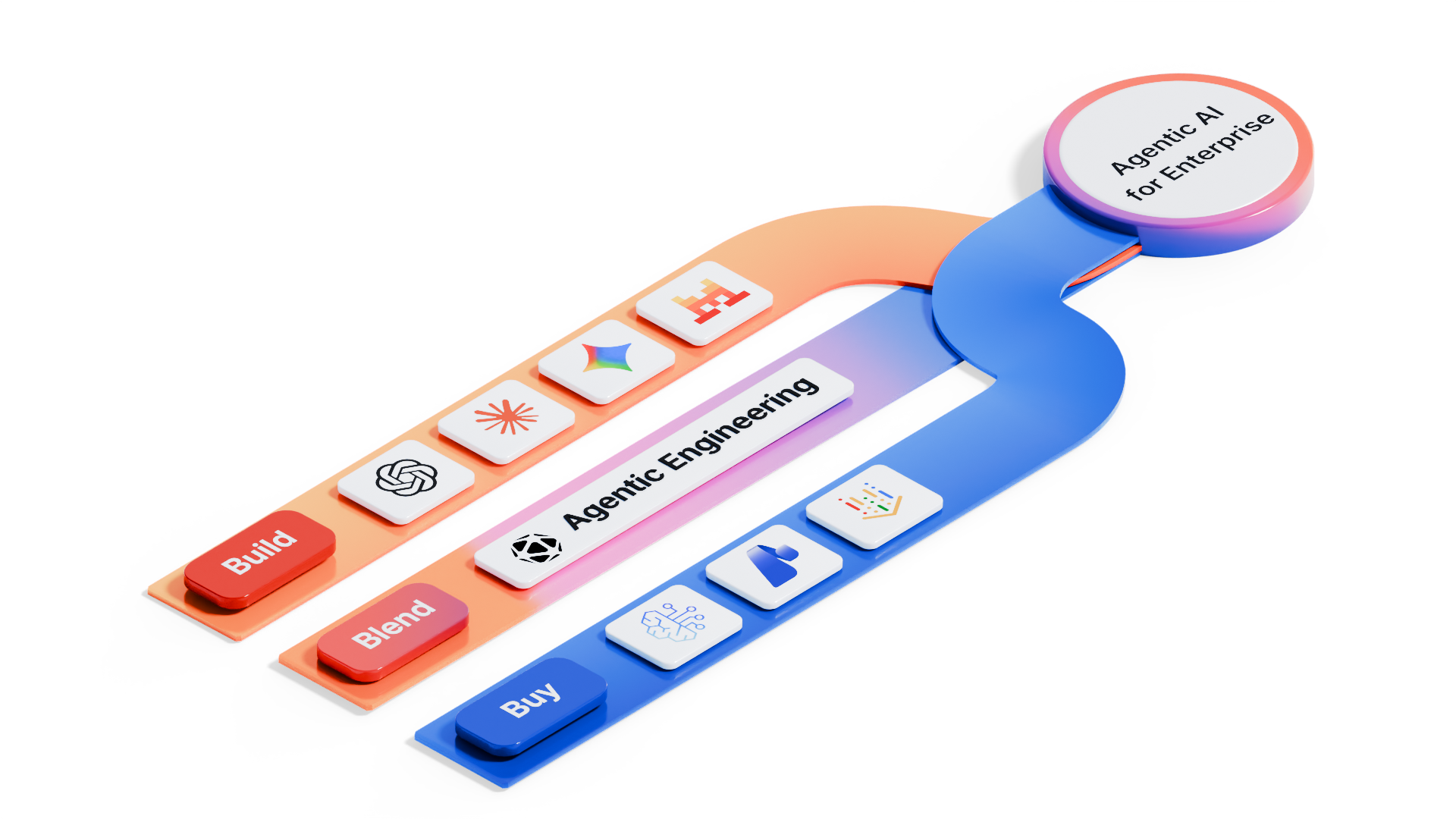
In the Gartner® build-buy-blend decision framework for selecting AI solutions, adopting an enterprise AI orchestrator you configure lightly is a "buy" decision, because it is primarily for, what Gartner calls "Defend" use cases.
The Gartner report defines Defend as where AI "augments individual productivity to maintain competitive parity." It is also the right call for general Extend work across functions like support, marketing, and operations. The Gartner report describes buy as "acquiring commodity core systems, such as ERP, CRM, HR and industry-specific platforms like core banking or electronic health records systems."
The trouble is that R&D engineering for physical products is not a general business use case. Your simulation set-up, your design methods, and the way your team turns requirements into validated parts are among the most differentiating intellectual property manufacturers own. Especially in highly regulated industries like automobiles, aviation, and defense, whatever AI is used to augment engineering work must meet stringent industry regulations.
That makes engineering an "Extend" use case, work the Gartner report defines as AI that "transforms existing processes or teams for competitive differentiation." Extend is exactly where a one-size-fits-all buy starts to under-deliver.
AI that advises engineering versus executes engineering work
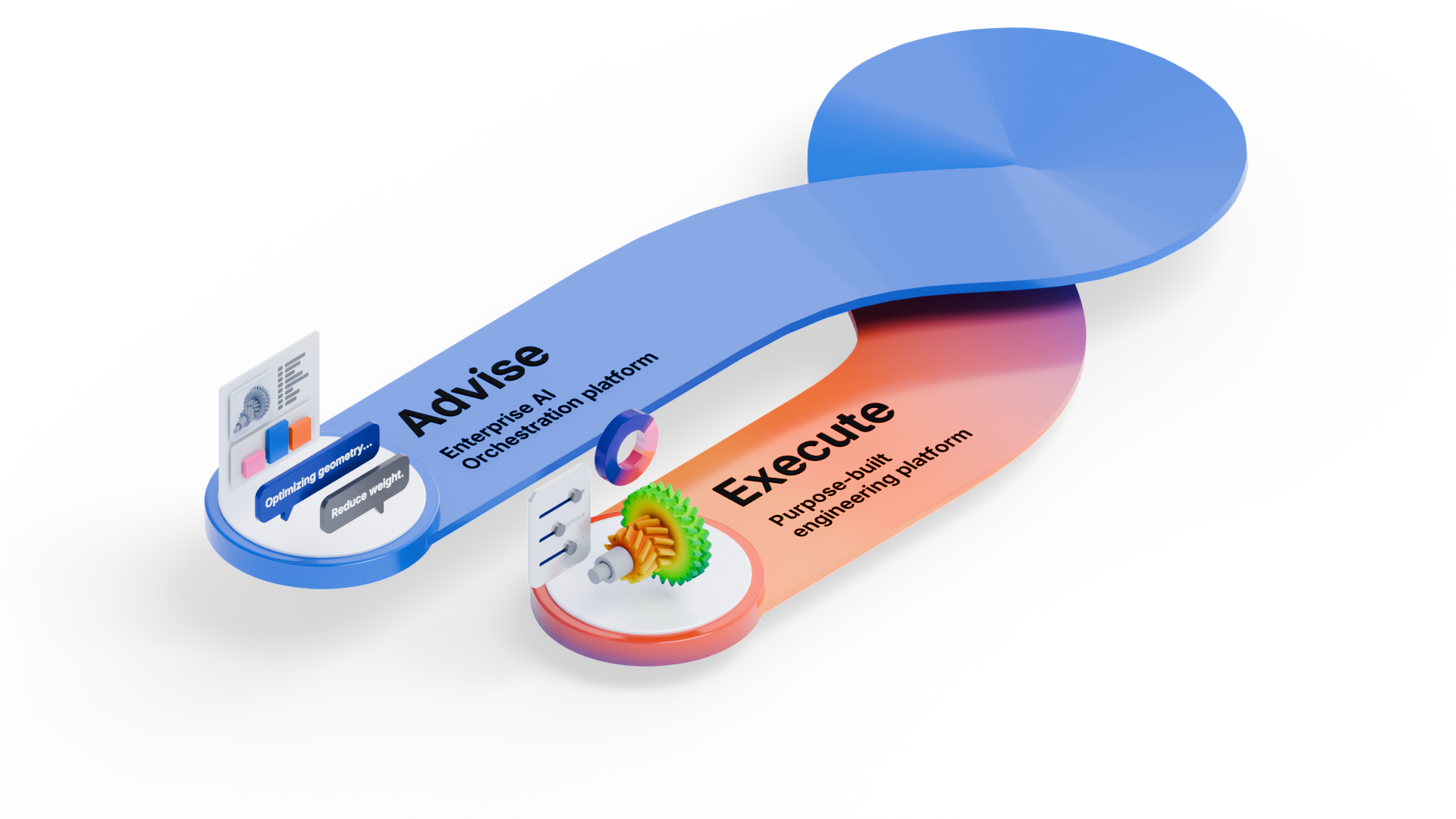
The cleanest way to see the gap is to separate what AI systems can do: advise or execute.
An enterprise AI orchestrator is built to reason over text and business data. Ask it about a 3D design and it will summarize documents, draft an explanation, suggest an approach. That is advising, and it is genuinely useful.
Though, to move the needle on engineering throughput, AI needs to do the work an engineer would. It means driving CAD, running a simulation, iterating geometry against constraints, and producing a validated result someone can sign off on. A platform built to reason over documents was not built to run a CAx toolchain or execute a mathematical engineering method. Enterprise AI can tell an engineer what it would do. It does not do it.
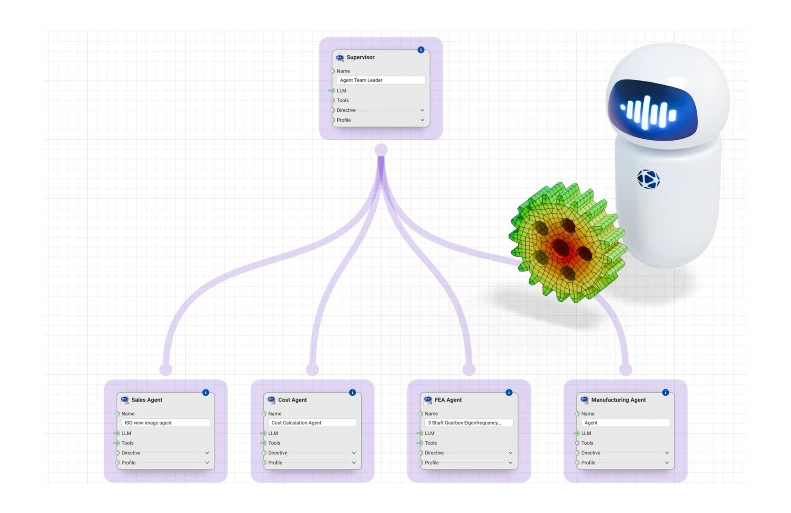
The reason is architectural. An enterprise AI orchestrator reads text, documents, and databases. It has no native access to 3D geometry. A purpose-built agentic AI solution for engineering, like Synera, embeds production-grade CAx kernels the agents can reach directly, so they open the CAD model, prep it, and run the analysis, rather than describing what they would do. That native access to 3D geometry is not something you can add to a platform with a few customizations.
Put simply: enterprise AI orchestration platforms advise. Synera executes.
One way to hold the distinction: an enterprise AI orchestrator is the company's nervous system, sensing and routing information across the business. Engineering also needs hands and a brain for the work itself, something that actually executes the method, validates against the requirements, and produces the part. A CAD kernel must be embedded by design, enabling agents to operate natively on 3D geometry, mesh, and results, so you are not bolting an enterprise AI solution onto data it cannot read. Execution is the harder problem than retrieval, and it is the one most enterprise AI decision-makers overlook for engineering.
What engineering AI tech stack decisions look like in practice
We saw this recently with a Tier 1 automotive supplier. Alongside an early purpose-built engineering proof of concept, the team ran a parallel build of an engineering agent system on an enterprise AI platform, with the vendor's delivery team supplying the orchestration layer. The platform was pitched as quick to configure. The team's own conclusion at the end: it was not. Most of what looked like simple configuration on paper carried real engineering complexity underneath, the kind that comes from decades of engineering experience in the gray areas that resist simple "if-this-then-that" rules.
Four things we saw:
- The build team lacked engineering domain expertise from the start. Enterprise AI orchestration platforms bring strong AI and automation capability, but not engineering domain knowledge. The core team building the agents didn't understand the underlying engineering processes, and that gap was never closed. The customer's team ended up re-explaining the same basic engineering concepts repeatedly instead of building on a shared technical foundation.
- What gets marketed as quick to configure is, in practice, prebuilt components and preset modules that were designed for business workflows. Engineering processes do not work that way. They vary by domain, by part family, by requirements, and the logic beneath even a modest customization gets complex fast. Enterprise AI orchestration platforms are calibrated for a very different type of business process that is not natively designed for simulations or 3D geometries.
- The usual plan is a progressive handover: the vendor builds the first version, then the customer's own team takes over maintenance and extension. That model works when what's being handed over is simple enough for an engineering team to own. Once the customer's engineers saw the actual complexity beneath the build, they reasonably concluded they weren't equipped to carry that development forward themselves.
- Roughly half a year into the engagement, the result was a sound concept for exactly one use case, running on a single agent. The engineering team set the build aside and moved to Synera instead. Tellingly, they kept the vendor's other enterprise products and remain satisfied with them. They just aren't used to run agentic AI for engineering. Engineering complexity does not disappear because a platform is marketed as quick to configure; it just moves downstream to whoever is left holding the workflow.
4 questions to ask before you build agentic engineering with enterprise AI
Before you conclude the enterprise AI platform you own covers engineering, put the decision through four questions. They map onto the decision factors in the Gartner report.
- Does the team building this actually understand our engineering domain, or only the orchestration technology?
- When someone calls this quick to configure or "low-code", what's the actual logic hidden inside the "prebuilt" components?
- Who owns this system in a year, and are they realistically equipped to extend it?
- What's the use case that proves this scales, and how long will that honestly take?
Engineering AI is a blend decision, not rip-and-replace
None of this means the enterprise AI orchestrator was a mistake. It means engineering is a different sourcing question with a different answer. This is a coexistence story, not a displacement one.
The Gartner report defines "Blend" as "the creation of custom-made features and functionalities that are not available in off-the-shelf solutions, allowing organizations to tailor their systems to meet specific business requirements." The Gartner report points to blend for differentiating work: keep the enterprise AI orchestrator for the business, and add a purpose-built engineering layer you configure and own.
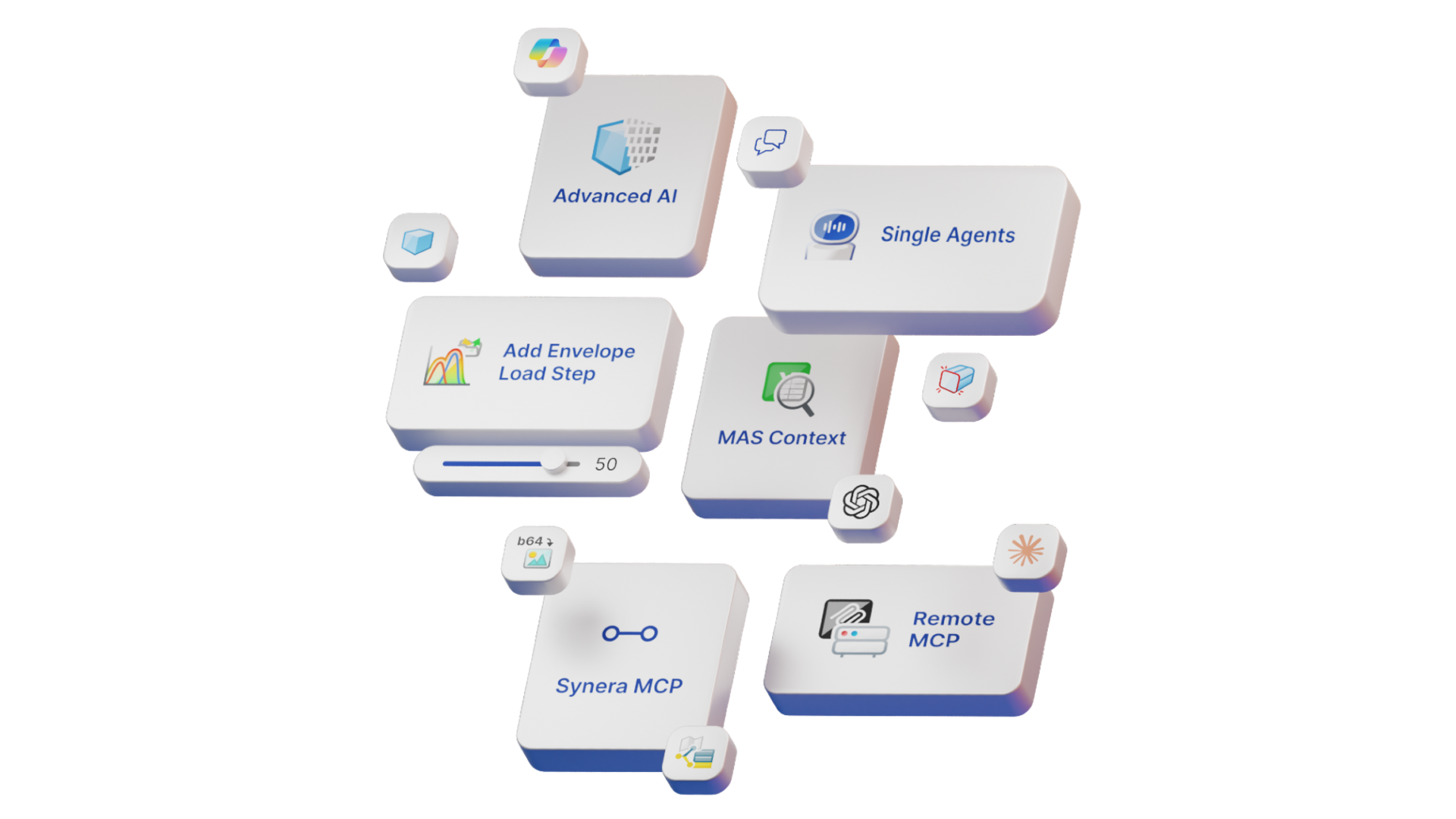
That is what Synera is, specialized agentic AI for engineering that executes rather than advises. It runs air-gapped on-premises, drives CAD and CAE tools, has 85+ add-ins and integrations off the shelf to engineering systems, and helps engineering organizations build deterministic, repeatable workflows engineers can stand behind. On-premises agents keep proprietary engineering data in your environment, which clears the security bar enterprise cloud AI usually can't.
Synera's forward-deployed engineers plus a template library for known use cases in automotive, aerospace, defense, and consumer products engineering mean the first use case follows a path that already worked elsewhere, and your team owns it afterwards. The enterprise AI orchestrator keeps doing what it is good at. Synera agents do the engineering part.
As Eric Stähle, Development Engineer, IMS Gear described using Synera: "We simply used Synera and the agent orchestration to connect everything together."
Synera connected directly to IMS Gear's existing tools: CAD, product data management (PDM), calculation sheets, costing tools. This meant there was no new platform to migrate to and no existing data shift to manage on top of existing engineering and business challenges. The integrations are maintained by Synera when CAx vendors change their APIs. Open and interoperable, compatible with A2A and MCP. Synera is the engineering execution layer under your enterprise orchestration, not a competing island.
Dr. Jens Fechler, Head of R&D, IMS Gear explains what changed after Synera: "At the beginning, I needed two of my engineers doing the RFQs, but today it can be done by one. Doing the same amount of quotations and then going even faster."
The takeaway
"We already have an AI platform for agents" is the right answer to a question about the business. Engineering is a different question. Walk through the Gartner build, buy or blend framework to determine the best conclusion for your engineering organization. Often, it's blend: keep what you bought, and add a system that executes the engineering.
This Gartner report is available until October 9, 2026; subscribe to the Synera blog for more Gartner reports and our engineers' practical breakdown of what's really happening in AI for engineering.
Gartner, How to Decide Whether to Build, Buy or Blend Your AI Projects, By Whit Andrews, Jim Hare, 9 April 2025.
GARTNER is a trademark of Gartner, Inc. and/or its affiliates.
About the Author:

Jeron Devadas
Senior Customer Success Manager
Jeron Devadas is a Customer Success Manager at Synera, where he provides strategic guidance and support to key enterprise accounts as they pursue digitalization and adopt AI agents in engineering. He helps engineering firms accelerate digital transformation and put agentic AI to work for smarter, faster product development. He holds an MSc in Computational Science from TU Braunschweig and a background in structural mechanics and product development, having previously worked at Bertrandt and the German Aerospace Center (DLR). Before moving into this more strategic role, Jeron was one of the early Solution Engineers at Synera, building automations for engineering companies. That hands-on engineering experience gives him insight into the exact challenges his customers are working to solve today.