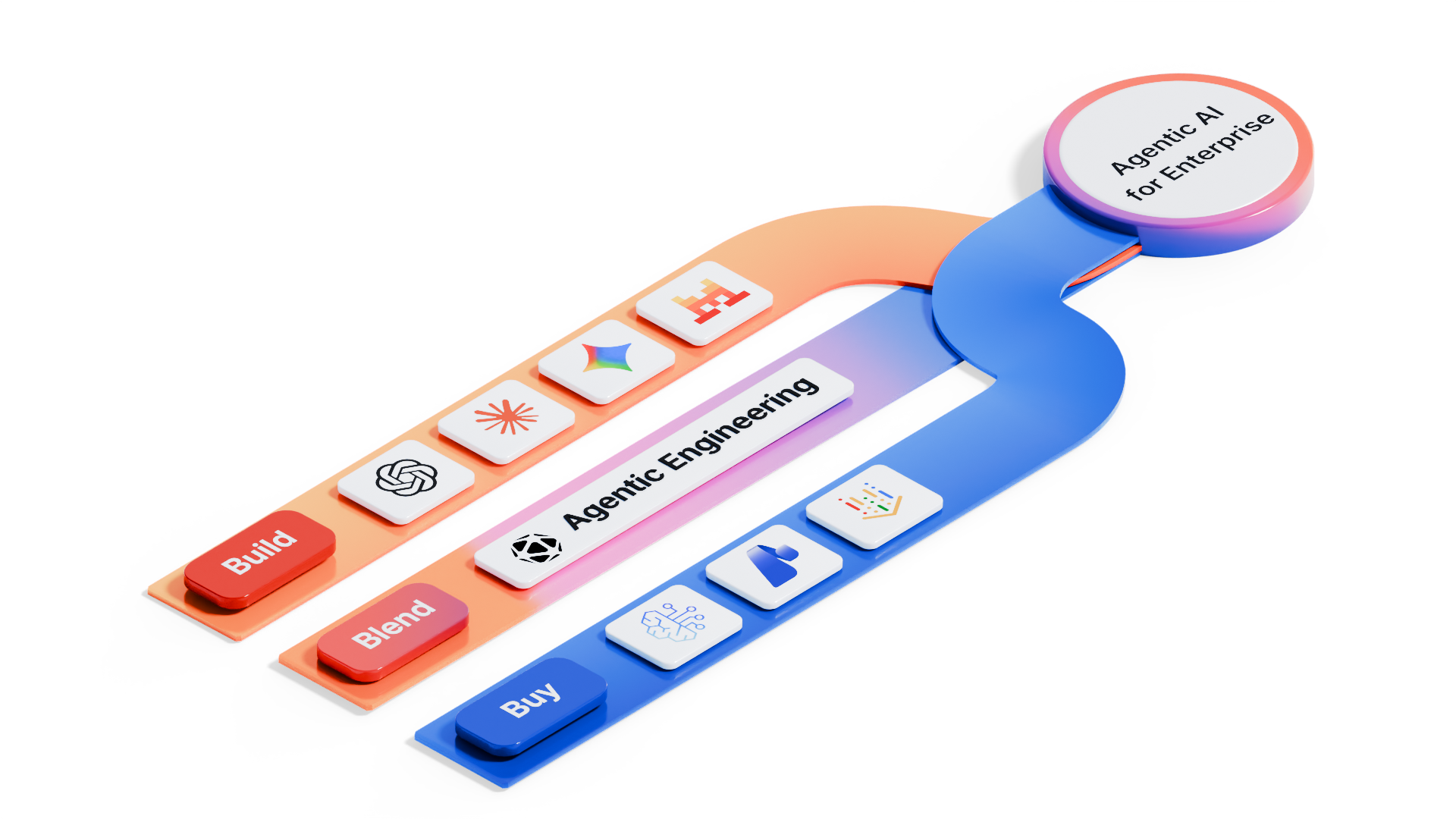
TL;DR. When does it make sense to build your own agentic platform for engineering? When should you just vibe code something with frontier models, and when does it make sense to buy a solution from a vendor? Gartner’s build, buy, or blend framework makes it clear: core R&D engineering is an “Extend” use case — “transforming existing processes or teams for competitive differentiation” — so both “we’ll use the enterprise AI platform we already own” and “we’ll do it ourselves” fall short. For competitive differentiating engineering work, we see that the purpose-built agentic AI solution Gartner calls “blend” usually wins.
Every R&D engineering organization is now having the same argument in some form:
- One camp says the company already has an enterprise AI orchestration platform like AWS Bedrock, Google Vertex, or Microsoft Foundry, so engineering should just use it.
- Another camp has vibe coded something together with Claude or Gemini and a few internal scripts, and says the team can build whatever it needs.
- A third camp is not sure what to decide and overwhelmed by all the AI options.
The argument feels like the familiar build or buy technology debate. It assumes the AI is solving a business problem with business data. But hardware engineering is different with different data: 3D geometry, and mechanical and physics problems to solve.
Gartner® has a neutral framework for the build or buy decision you can apply to help guide your AI for engineering decision. This article offers my expert take on applying the framework in practice.

What the Gartner framework actually asks
The useful move is to stop treating AI as one undifferentiated enterprise project. When you do, R&D engineering turns out to be the case most teams categorize wrong.
Gartner sorts every AI project into one of three buckets, based on its strategic purpose.
- Defend — AI that “augments individual productivity to maintain competitive parity.” Nothing about the work really changes. Think of a tool that analyses reports quicker or helps a coder finish sooner.
- Extend — AI that “transforms existing processes or teams for competitive differentiation.” The work still exists, but AI transforms how well you do it, ideally for a competitive advantage. Think of specialized solutions that can do one domain really well.
- Upend — AI that “disrupts by creating new value propositions, products or markets.” It's a bigger, riskier bet, but the payoff can be huge. Think of using AI to discover a new medicine.
Gartner also lists nine factors that CTOs should consider when deciding whether to buy or build AI for engineering.
Those factors span how much the capability differentiates you, how fast you need it, whether the skills exist in-house, how much control and security you require, total cost of ownership, and data readiness.
The path from here is intuitive, once you see it:
- Defend work leans toward buy, because you want the off-the-shelf efficiency without spending scarce talent on it.
- Extend work, the differentiation layer, is where a purpose-built solution shines, because you need something better than one-size-fits-all, but you don't want to lose time and resources inventing the foundation yourself.
- Upend work leans toward build, because genuine disruption is hard to buy off a shelf.
Agentic AI for engineering is an “extend” solution
Here is where most teams slip. They file AI for engineering under “helps teams do their work better and faster,” essentially mis-labeling it with a “defend” purpose.
But R&D engineering is not a general efficiency strategy for the business. Simulation and design methodology, materials know-how, and the way your team turns requirements into validated parts are among the most differentiating things your company does. That is textbook “extend.”
Once you correct the purpose label, the decision logic sharpens, and the two common options I see buyers considering start to wobble:
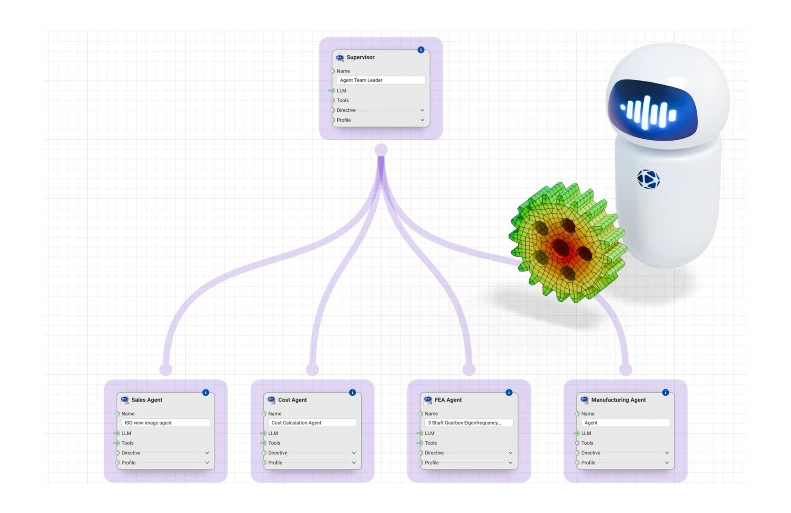
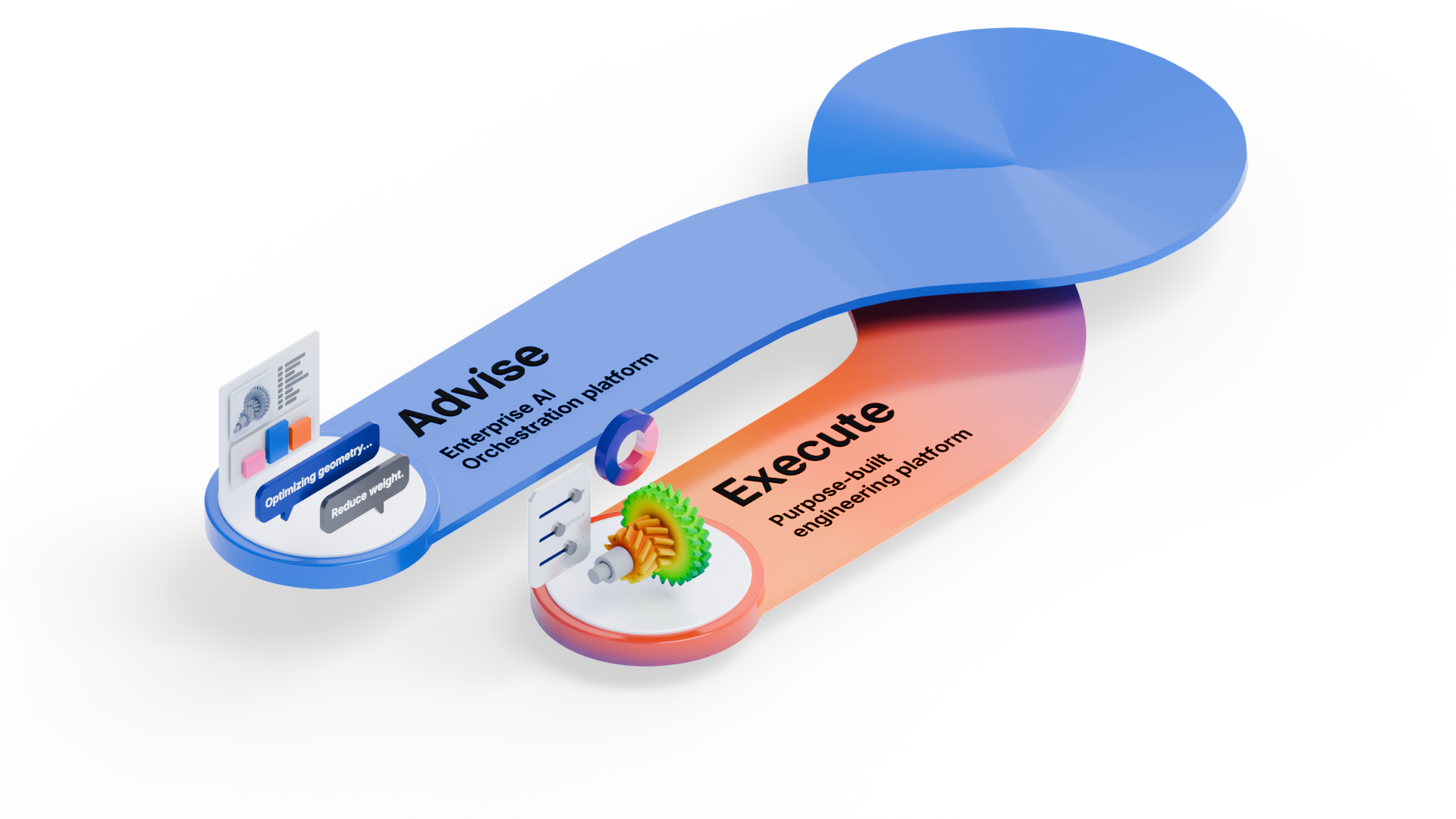
- "We already have an AI orchestrator in house": Focusing on using existing technology within the organization, Microsoft Foundry, Amazon Bedrock, or similar, is reasonable for efficiency work across the business. It is incomplete for engineering, because a horizontal AI orchestrator is built to reason over documents and business data, not to mesh 3D designs using a validated engineering method or run simulations with output engineers can sign off on. Enterprise AI agents can advise. They cannot execute engineering work, because they don't have native kernels to handle 3D geometry and aren't designed to capture the “how” behind engineering calls that live in your senior engineers' heads.
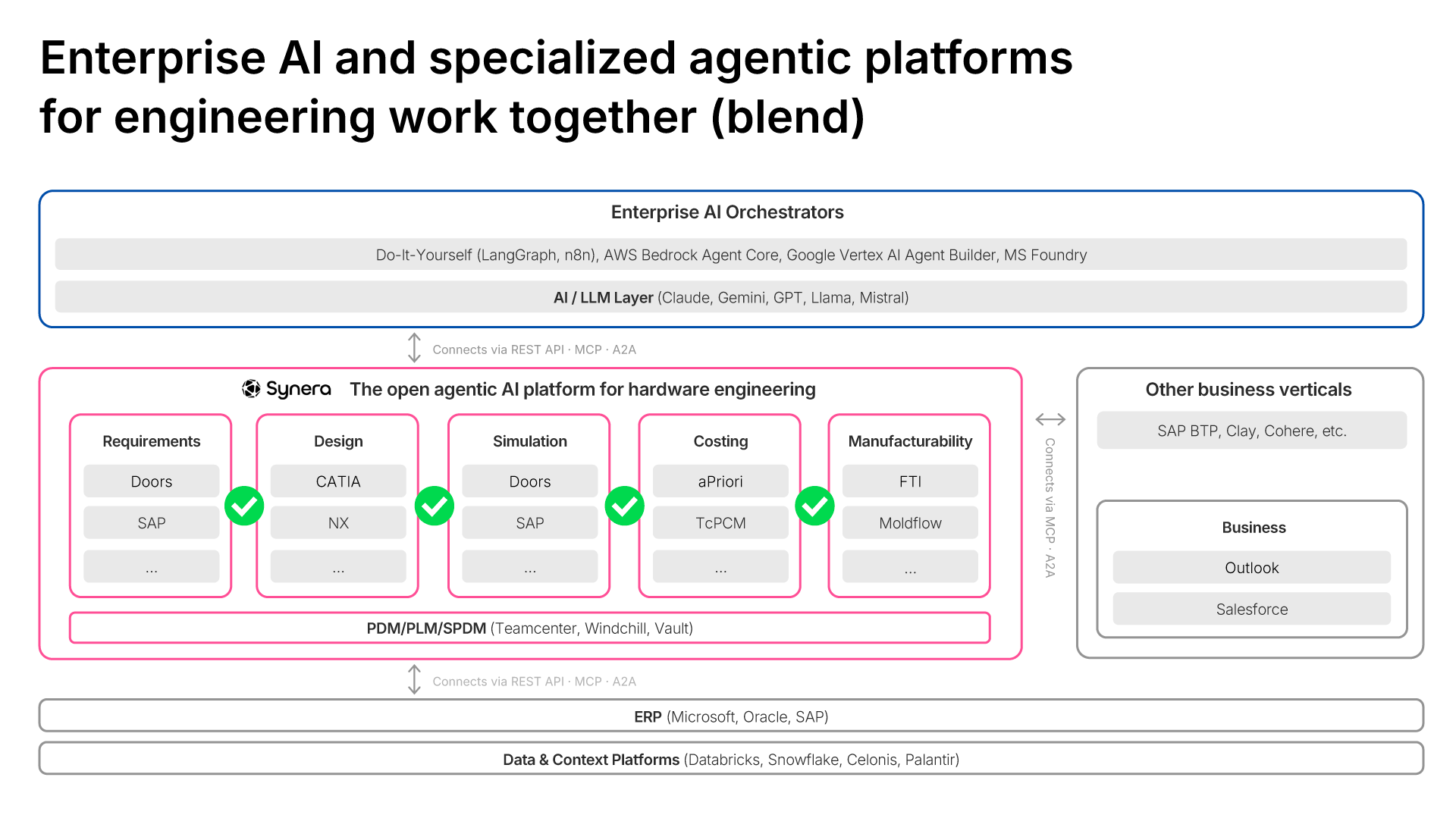
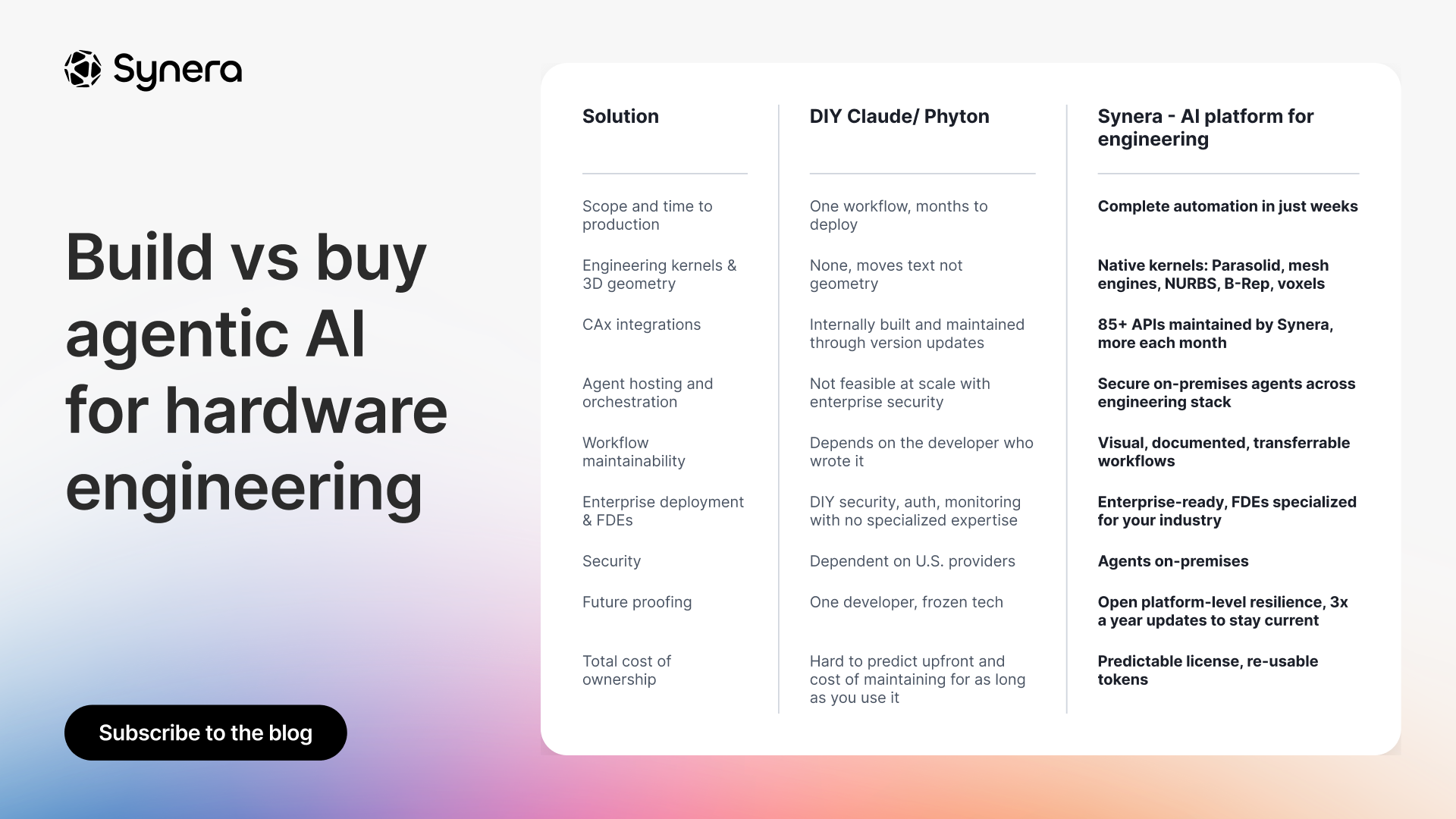
- "We'll build it ourselves with Claude": Reasonable on the surface, because vibe coding and creating agents with Claude, GPT, and Gemini is so easy. It feels cost-effective because an automation prototype can be created in a day and MCP integrations are increasingly available to your engineering tech stack. The nine factors by Gartner show what this path really asks of you over time. You have to keep it connected to your CAx, PLM, ERP, and other company tools. It has to run the same way every time, so you can trust the results. It has to survive the builders leaving to work on new projects and AI models changing. And it has to scale to serve your whole engineering team, not just power one workflow.
Why the Gartner “blend” is usually the answer
If a one-size-fits-all “defend” buy leaves the execution gap open and a full do-it-yourself build carries a maintenance and security bill most teams underestimate, what Gartner calls “blend” is what's left. For engineering it is usually the strongest option, not the compromise.
Blend means a platform purpose-built for engineering work. You get the differentiation of a system shaped around your in-house IP with the total cost of ownership of something you did not have to construct or maintain from scratch. In Gartner terms:
Blending is an attractive choice for “extend” features and projects because many of these efforts become a commoditized “defend” category with time. Blending enterprise-specific capabilities with more customizable commercial products is an effective way to deliver particular capabilities in a shorter period of time.
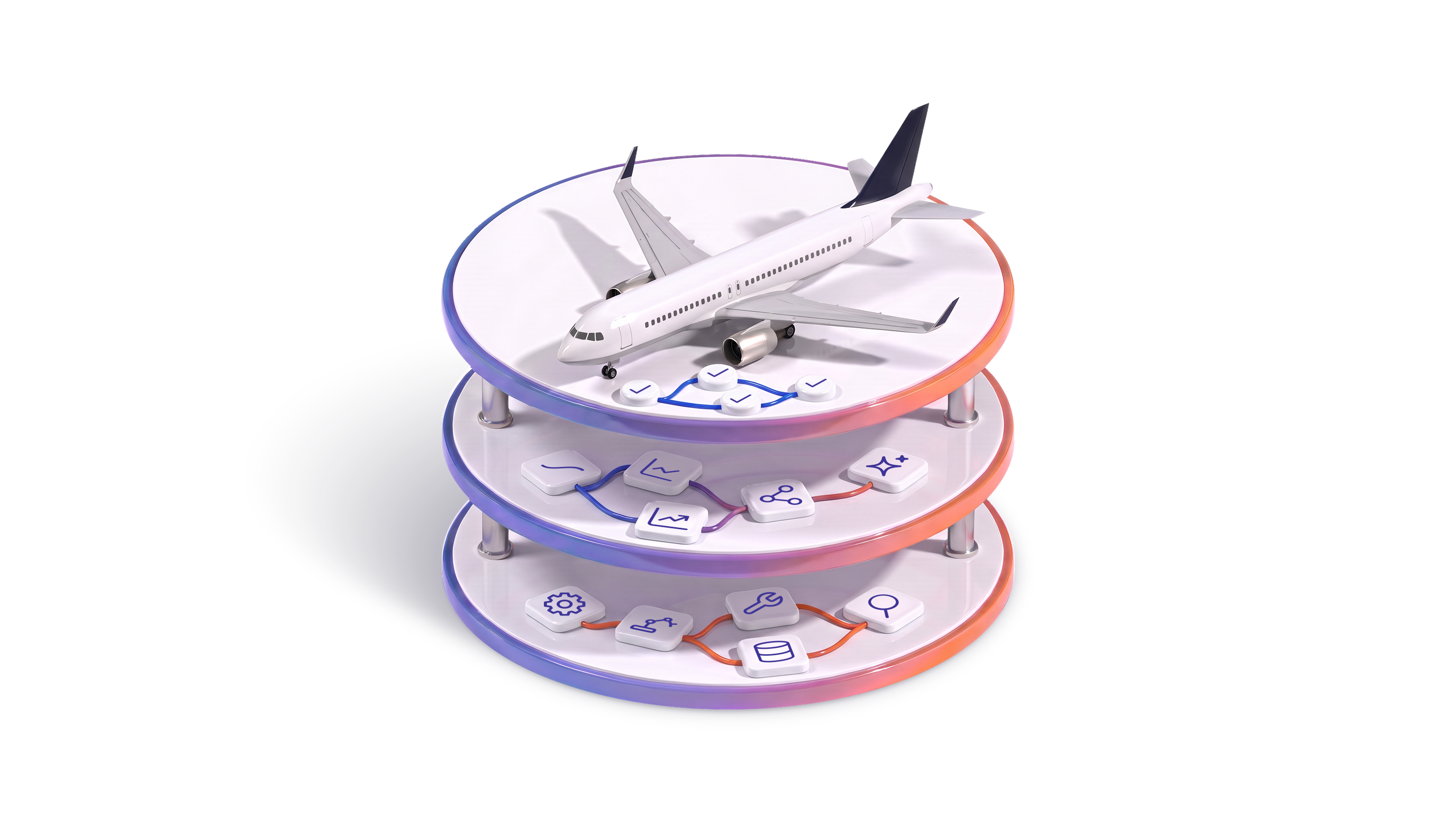
This is the category Synera is built for: agentic AI for engineering. The distinction that matters is execution on engineering work. It runs engineering workflows on-premises, so proprietary designs and methods stay inside your own boundary, drives the CAx tools your engineers already use through 85+ add-ins and integrations, and produces results as deterministic, repeatable workflows with an audit trail an engineer can stand behind at sign-off. That last part is not a detail. In regulated and safety-critical engineering, an automation you cannot reproduce or explain is not an automation you can use.
What agents “executing on engineering work” looks like in practice
The gap between agentic orchestration that advises and agentic execution of real work is easiest to see in the outcomes engineering teams get when the AI agents actually run in live operations.
Many automotive tier one suppliers and 6 of the top 10 OEMs worldwide by revenue rely on Synera, including:
- BMW transformed a 3-week design cycle into 2 minutes.
- IMS Gear cut quote time by 99% with Synera.
- At SEAT, a Volkswagen Group subsidiary, engineers answer the manufacturability question in 30 minutes at the design phase.
NASA, Airbus, Safran, and Arianespace are among the aerospace and defense organizations that run engineering on Synera:
- At Airbus, request-for-tender turnaround moved from 50 hours to 7 minutes.
- At NASA, design exploration that once took two engineers two days to produce four variants now lets a single engineer explore more than 100 variants in an hour.
Ryan McClelland, Research Engineer at NASA Goddard Space Flight Center, explains how they deploy AI agents in the video below.
These are not efficiency boosters via chat results or Claude created markdown files of processes and senior engineering IP. They are what happens when the agentic system executes a validated engineering workflow end to end across CAx tools, on infrastructure the company controls, with results the team can reproduce.
And they are not isolated pilots: Synera agents run in live operations, the platform has more than 170,000 workflow automations, and we pair customers with forward deployed engineering trained in AI and their engineering fields. This is agentic AI for engineering as an “extend” and blend solution, rather than settling for a “defend” efficiency buy or an expensive “upend” build.
If you’d like to explore how it works, watch our 7-minute demo and we’ll reach out to schedule a consultation and tailored walkthrough of Synera.
Run your own build, buy, or blend analysis
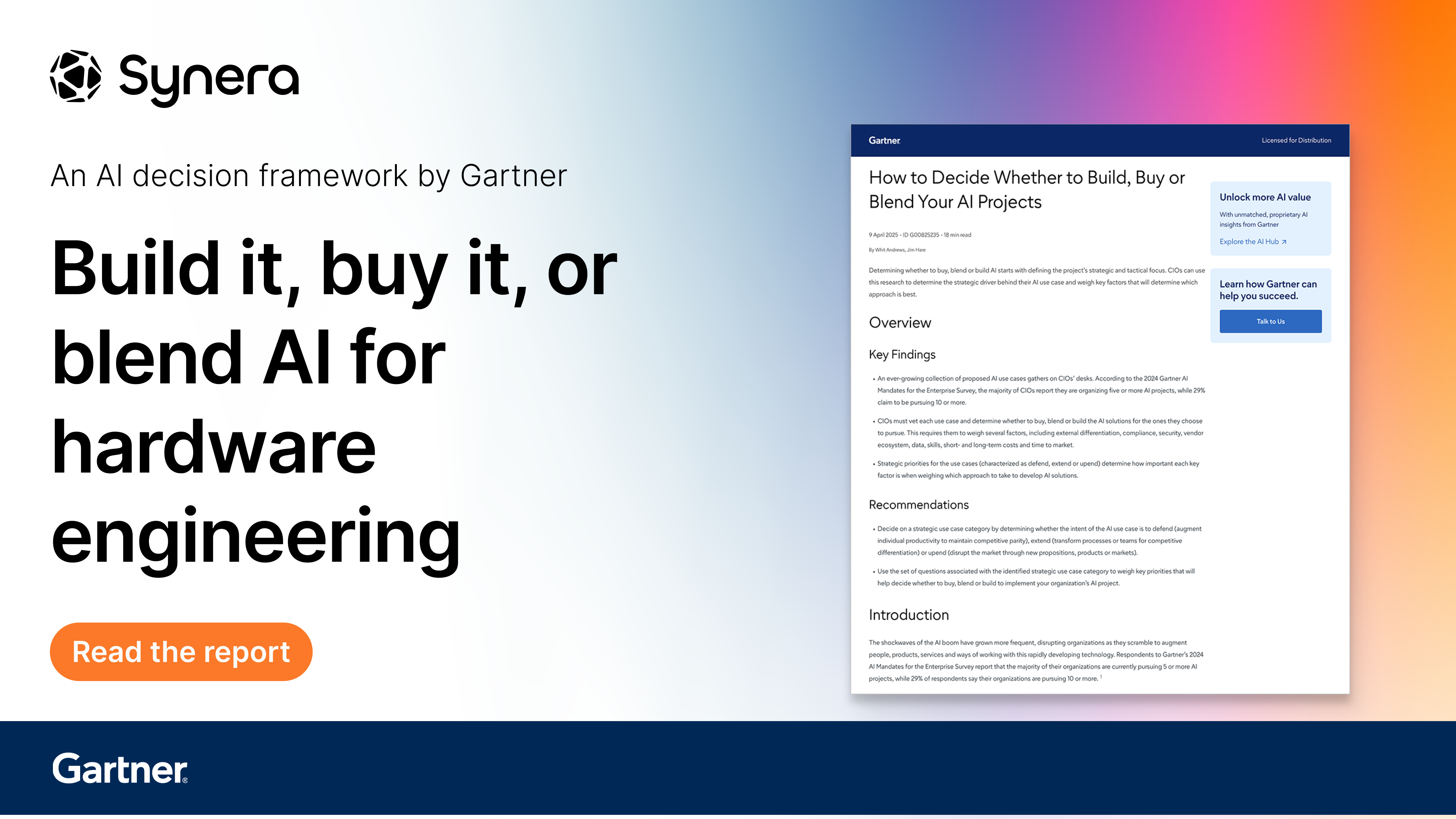
Download the Gartner report until October 9, 2026 before they retire it from their research library.
Whatever you conclude, the framework is worth the hour. The Gartner report lays out the full build, buy, or blend logic and the decision factors in detail, and it is a neutral place to start the conversation with the stakeholders in your organization.
Gartner, How to Decide Whether to Build, Buy or Blend Your AI Projects, By Whit Andrews, Jim Hare, 9 April 2025.
GARTNER is a trademark of Gartner, Inc. and/or its affiliates.
About the Author:

Zulfitri Zulkarnain
VP of Sales, North America
Zulfitri Zulkarnain is VP of Sales, North America at Synera, where he leads go-to-market strategy and revenue growth for the company's agentic AI platform. He works with engineering and R&D leaders across automotive, aerospace and defense, and consumer electronics, helping their teams bring agentic AI into everyday engineering workflows.
Zul spent more than 20 years in engineering simulation, AI, and high-performance computing at Altair and Siemens Digital Industries Software, where he built and scaled sales and technical teams across the U.S. and internationally. That background gives him a firsthand understanding of how engineering teams actually work, and what it takes to get new technology adopted at scale.
He holds an MBA from UCLA Anderson School of Management and a Bachelor of Science in Mechanical Engineering from Kettering University (formerly General Motors Institute).