TL;DR
- Scaling agentic AI in engineering rarely fails on technology. Pilots stall because the organization is not ready for the size of the impact.
- A team of agents can replicate a whole cross-department process flow. That changes roles, responsibilities and decision paths, so it needs a transformation program, not a tool rollout.
- Run the transformation program in parallel to the first pilot: strategy and PMO, governance and quality gates, IT readiness, and people enablement.
- Start small and start now. Deterministic workflows under the agent layer keep risk controllable, and you do not need perfect data to begin.
- The panel at the Future of Engineering Summit agreed: internal ownership, quantified ROI and process redesign separate teams that scale from teams that stay in pilot mode.
Your first agentic pilot worked. A team of agents cut a multi-day engineering workflow down to hours. The engineers who tested it are convinced. Six months later, the pilot is still a pilot. Nobody owns it, IT has open questions, and the next use case is waiting for a budget decision.
This is where most efforts at scaling agentic AI in engineering get stuck. At the second Future of Engineering Summit in March 2026, nearly every speaker named the same problem. Ryan Qi of AWS shared a Gartner projection that more than 40% of agentic AI projects will be canceled by the end of 2027. He pointed to rising cost, unclear business outcomes and weak risk controls, not to the technology itself.
In my session, I talked about why agentic AI is a transformation and not another tool. In the panel that followed, Dr. Nina Korshunova, Dr. Jakob Lohse, Bruno Finco and I discussed what actually moves pilots into daily operations.
This article covers three things: why pilots stall, the four workstreams of a transformation program that takes them into daily operations, and a two-speed roadmap you can start with this quarter.
Why scaling agentic AI in engineering is a transformation, not a tool rollout
A new simulation tool optimizes one step in one department. A team of agents works differently. It can replicate a full process flow that today spans several experts and several departments.
What a design-to-cost team of agents does
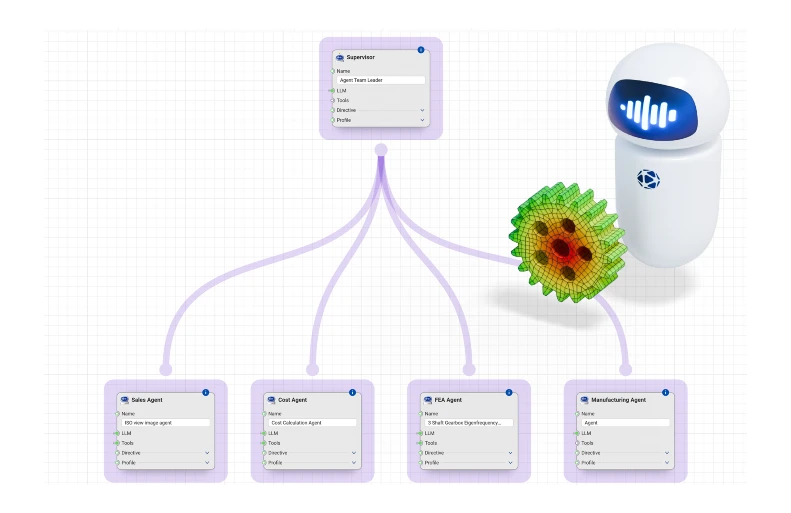
In the session, I showed a simplified design-to-cost agentic system example. Engineers talk to a supervisor agent through a chat interface. Behind it sit specialized agents:
- A geometry agent that prepares the uploaded part for analysis.
- A simulation agent that runs a forming simulation to check manufacturability.
- A costing agent that pulls from cost databases and asks for missing inputs such as country, part volume and energy mix.
The agents evaluate, interpret and act. They decide among themselves which agent takes the next step. In the demo, they flagged undercuts that made the part impossible to manufacture. That is where they stopped and handed the result back to the engineer.
The engineer fixed the geometry in CAD and asked the team to rerun the check, this time with a cost and CO2 report. The final report showed improved manufacturability and a cost estimate.
Why this changes the organization
The handoffs between these agents used to be emails, phone calls and meetings between people. When agents take them over, roles and responsibilities change with them.
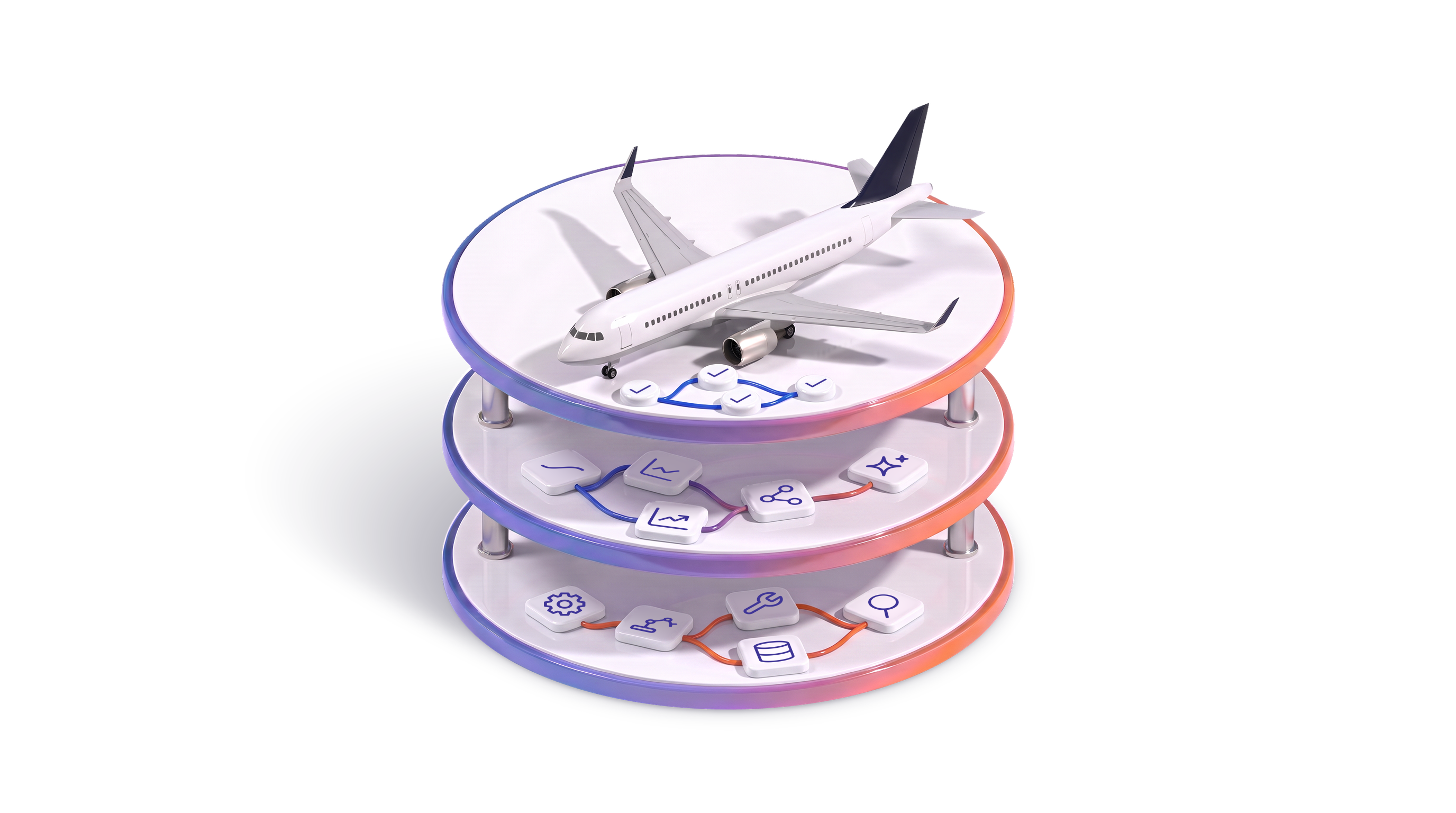
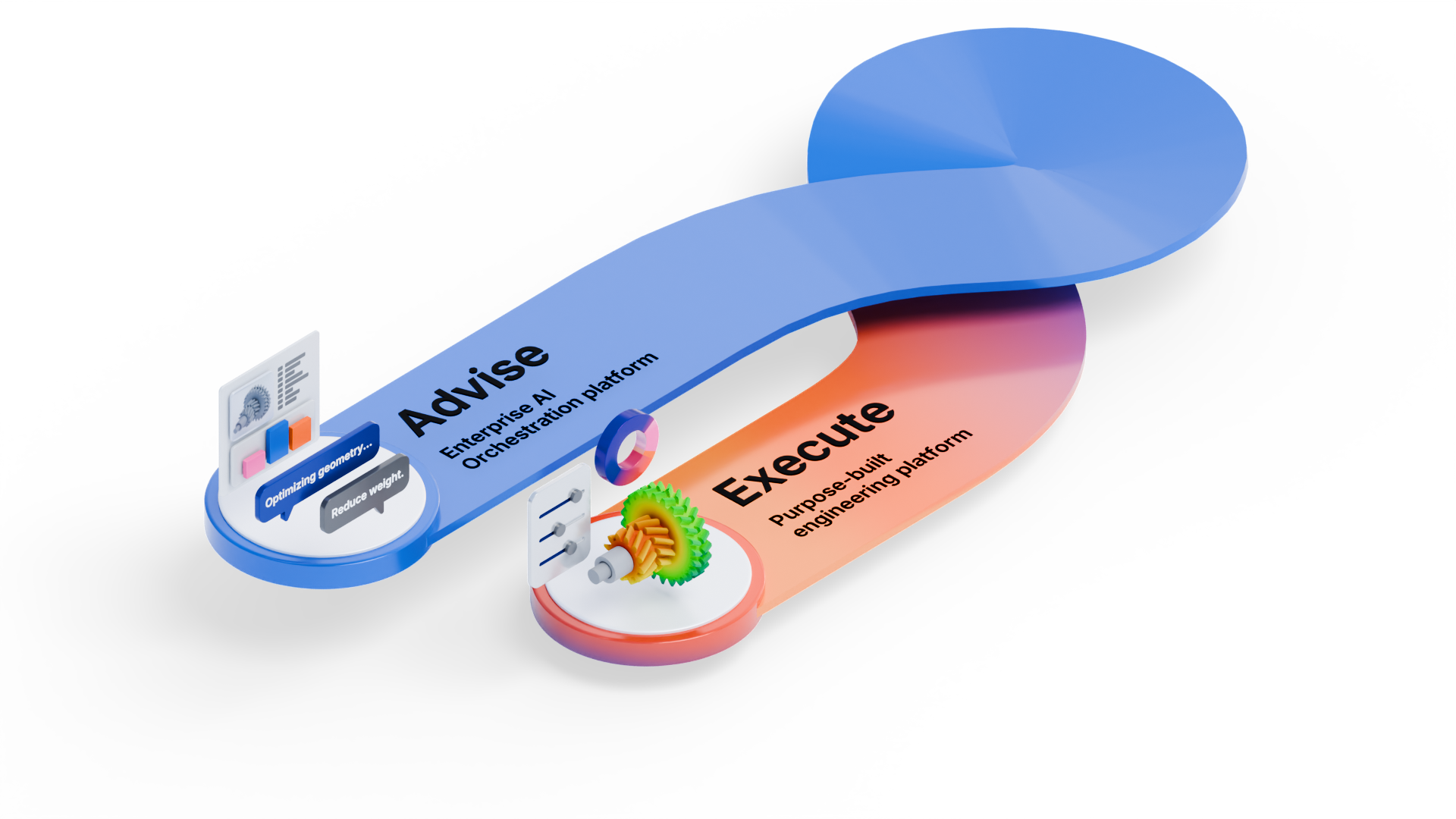
Under the agents, the actual engineering still runs in deterministic, repeatable workflows connected to the tools you already license. Connector add-ins such as the Ansys Connector control licensed solvers, and translators such as the CATIA Translator move geometry in and out. The physics stays rule-based. The agents choose which workflow runs next.
The pilot paradox: when impact outruns the organization
The second reason agentic AI projects must be considered transformations is the sheer size of the impact they create on an engineering organization. In our client projects, the first pilots typically cut workflow time by 90% or more within six months. And while that sounds like a powerful impact, those numbers often become the reason pilots get stuck.
When I presented these results at the summit, I emphasized that the numbers were so remarkably high that they could fundamentally change the organization, creating an interesting paradox.
A single workflow that suddenly runs ten times faster raises questions nobody planned for:
- Who owns the system now, and who maintains it?
- What criteria does it have to meet before engineers use it in daily operations?
- Which use case comes next, and who decides?
- How do the roles of the engineers change when agents take over their handoffs?
If these questions only come up after the pilot succeeds, the pilot waits. The fix is to answer them in parallel to the first pilot, not after it.
The four workstreams of an agentic AI transformation program
The framework we use with clients to ensure organization-wide agentic AI success is a standard transformation framework. What matters is that each workstream starts while the first pilot is still running.
1. Strategy and a PMO that drives the scaling
Most companies are moving from scattered single use cases to an organized approach. That needs a project management office (PMO) with a clear mandate. The PMO can:
- Run a use case funnel that looks beyond the current pilot.
- Set the governance for prioritization: what comes next, what moves into daily operations, and on which criteria.
- Define the roles that drive the transformation.
2. Governance, quality management and IT
This is the backbone. Before you can scale, you need answers to three questions:
- Quality: When is a team of agents ready for daily operations? Where do you need human review gates? How do you monitor performance over time?
- Versioning and documentation: Every team of agents needs a version history and clear documentation, so others can use it and results stay traceable.
- Ownership and risk: Who has oversight? A single pilot does not need formal risk management. An agentic workforce with hundreds of agents does.
IT carries the technical side: data connectors, on-premises deployment and model management.
3. Organization and roles: the human above the loop
Today, many decisions run through iterations between experts until they reach a committee. With agents, one engineer can sit above the loop. That engineer controls one or several teams of agents, stays responsible for the result, and brings it to the decision committee. Behind that simple picture is a full change of roles and responsibilities, and it frees engineers for creative work.
4. Communication and people enablement
This workstream is neglected in almost every transformation I have seen. A top-down mandate from management is essential. You also need bottom-up ownership from engineers who are motivated and enabled. In practice, that means a champion network, training for champions, self-onboarding for everyone else, and sounding boards where teams can voice doubts and new ideas.
Pilot mindset vs. transformation mindset
The difference shows up in how each question gets answered.
A two-speed roadmap for agentic AI in engineering
A common objection in the panel Q&A was: our data is not ready, and we lack the controls to trust agents. My answer is that these things matter for scale. They do not matter much for the first step.
There’s no fast followers in this case. The fast follower strategy, I think, is not working here because this technology is developing so fast.
Run two speeds at once
The long-term speed is strategic. Define the North Star for how engineering should work in the future, then break it down into what you need from AI. The short-term speed is pragmatic. Take technology that is deployable now, implement it on one process, and learn. The two meet in the middle.
How to start this quarter
- Pick one repetitive process. Moritz Maier, Synera’s CEO, has a rule of thumb: if you do a task three times, think about automating it.
- Check whether it needs agents at all. Bruno Finco put it well: scripts automate computer work, agents automate human work that needs judgment. Sometimes a workflow alone is the right answer.
- Put the physics in deterministic workflows. Agents use language models that can hallucinate. The workflows under them run rule-based geometry, simulation and costing steps, which limits that risk.
- Keep a human in the loop at critical points. Map each step from non-critical to critical, and add review gates where the risk sits.
- Measure against the manual baseline. Run the same case by hand and with agents, compare quality, then quantify the time saved.
- Set up the PMO in parallel. Do not wait for the pilot result to plan the next three use cases.
What the phases look like
In our client projects, the first six months are a discovery phase. It proves feasibility on single workflows with individual engineers. With a transformation program in place, the next phase speeds up full processes at a larger scale. The third phase reaches time to market. That is where we have seen returns on investment above 650% for the technology alone.
What the panel added: ownership, validation and process redesign
Moderator Rachael Pasini of Design World asked the panel where agents already deliver and what holds teams back. Four points stood out.
Strategic intent and an owner after the pilot
Nina Korshunova, Head of AI Engineering at the appliedAI Initiative, sees projects across European startups and large enterprises. Her view: without strategic intent and C-level sponsorship, projects stay in pilot mode. She also named an ownership vacuum. After the excitement of a pilot, someone has to own the data, the application and its maintenance. In Europe, the EU AI Act adds requirements that teams often overlook until rollout.
It is not just a project, it’s a whole rethinking of all of the processes, organization, culture, tools, architecture.” Nina Korshunova, appliedAI Initiative
Redesign the process instead of fitting agents into it
Nina pointed to the established process models many R&D organizations run on. Teams of agents do not fit neatly into them. Most companies also work with legacy CAD and product lifecycle management (PLM) systems they cannot replace. Her advice was to redesign the process so it suits agents, while respecting that brownfield reality.
Internal champions and quantified ROI
Bruno Finco, Co-Founder and CTO of MOVEdot, said his most successful deployments had an internal owner who understood both the system and the engineers. Adoption then spread from one division to the next. His best customers ran the same cases manually and with agents, matched the quality, and measured the time difference. Once ROI is quantified, expansion follows.
Domain experts in every layer
Jakob Lohse, Senior Product Manager at Autodesk, stressed two technical prerequisites. Teams need structured data sets to train their own models, and enough API functionality for agents to orchestrate. Domain experts should be involved in every layer of an agentic workflow, because output quality has to hold up to engineering standards.
Looking at 2027
Asked what will separate leaders from laggards in a year, the panel converged on throughput. Bruno compared it to software, where agents already multiply development speed. My own expectation is shorter product cycles across automotive, medical technology and other industries: more output from the same people, accelerated by agents.
The other sessions at the summit
The summit had four more talks. Each is worth watching in full.
- Keynote: Luca Zampieri and João Moura, Neural Concept: A timeline of AI for engineering, from deep learning on 3D geometry to physics-aware design copilots. They described “pilot purgatory” and argued for moving from proofs of concept to proofs of value.
- Ryan Qi, AWS: Definitions of AI agents and multi-agent systems, a four-level autonomy framework and a cloud-based agentic tech stack. He showed a CAD agent in Onshape, a joint request for quotation (RFQ) demo with Synera, and Blue Origin’s company-wide agent adoption.
- Jakob Lohse, Autodesk: How predictive and generative AI models bring aerodynamic insight into automotive design reviews. His point: AI shifts simulation left, so decisions can happen in the meeting instead of a week later.
- Bruno Finco, MOVEdot: A live demo of agents analyzing damper test data, linking driver feedback, lab tests and simulation. He framed agents as an AI layer between engineers and the data they never have time to review.
Start the pilot and the program on the same day
The one change to make: stop treating the transformation program as the step after a successful pilot. Start both together. Run the first team of agents on one repetitive process, keep the physics in deterministic workflows, and set up the PMO, quality gates and champion network alongside it. By the time the pilot proves its value, the organization is ready to scale it.
Watch the full sessions. All recordings from the Spring 2026 edition, including my session and the full panel, are available on demand. Watch the recordings.
Join the next edition. The third Future of Engineering Summit takes place online on November 3, 2026, at 6 PM CET. Its theme, “From Pilot to Rollout - What AI Agents Are Actually Delivering in Engineering” picks up exactly where this discussion ended, with engineering teams sharing what is running in daily operations. Registration is free. Register for the November edition.
About the Author:

Dr. Marc-Florian Uth
Senior Account Executive & Strategic Partnerships Lead
Dr. Marc-Florian Uth has worked with and for organizations in various industries, from automotive to industrial goods and medical technology, supporting complex engineering and R&D environments at the intersection of R&D transformation, AI, and scalable product development. With a background in computational engineering and years of experience with enterprise R&D teams, he helps engineering leaders rethink how complex systems development processes are optimized, automated, and scaled. His work at Synera focuses on applying agentic AI and workflow automation to reduce engineering bottlenecks and accelerate time to market across global teams. Marc regularly collaborates with SVPs of Engineering and Chief Technology Officers to translate AI capabilities into practical, production-ready approaches that fit real-world constraints. He brings a grounded, systems-level perspective on how engineering organizations can evolve processes, organizational models, tooling, and decision-making as complexity and global competition increase.