TL;DR. SEAT, part of Volkswagen Group, is moving manufacturing feasibility from the end of body-in-white development to the front. At CDFAM Barcelona, the team demonstrated a team of agents on Synera executing the forming simulation, evaluating manufacturability, and returning a structured verdict. This gives designers an answer in the design stage rather than after tooling is locked. First benchmark from the CDFAM demonstration: a feasibility assessment that used to take four weeks now runs in about thirty minutes.
The manufacturing question at SEAT was arriving after every downstream commitment had already been made
Body-in-white (BIW) is the stage in car manufacturing where the vehicle's structural frame is assembled from sheet metal components, before the engine, interior, and exterior panels are fitted. It is the skeleton of the car. The decisions taken at this stage determine weight, crash performance, passive safety, and production cost.
At SEAT, body-in-white development had always followed the same order: design first, simulation second, manufacturing validation last. This is how knowledge flowed in the organization across departments, but the cost multiplied every time a decision arrived later in the cycle.
The right expertise existed inside SEAT. It just arrived at the wrong moment.
SEAT moved from workflow automation to agentic AI while most of the industry was still scoping pilots
SEAT and Synera began working together in 2025 on engineering workflow automation. The early production results confirmed the ceiling was ready to move:
- A body-in-white optimization that ran for 42 hours reduced to 1 hour.
- A two-hour task reduced to 5 minutes, and more precise than before.
- A six-hour design optimization reduced to 5 minutes.
Those numbers were significant on their own. However, building on these successes, the SEAT engineering team decided to add an agentic AI system to their manufacturing feasibility process to optimize speed and quality decisions.
We are breaking the ceiling. The reduction in time is important, but so is the precision and the quality in general.
Juan de Dios Escribano Felguera, Manager SEA/EK-K1 Body Development & Corrosion Protection, SEAT
SEAT's body-in-white engineering team chose to bring the simulation to the designer. Working with Synera, they built a team of agents for manufacturing feasibility analysis of sheet metal components. The first live component analyses ran ahead of CDFAM in April 2026, and the system with the potential to shrink 4 weeks of work into 30 minutes, is now scaling across SEAT's body-in-white program.
How the manufacturing feasibility agent works: a supervisor and specialist agents built on tools SEAT already uses
Synera is the open agentic AI platform for engineering, connected across every tool in your R&D tech stack.
At SEAT, that translated into a team of agents structured in three layers on top of the existing engineering toolchain:
- Foundation: Connectors to CAD software, Altair simulation tools, and the material database, giving the system the same data engineers work with directly.
- Automation layer: Rule-based engineering workflows handle forming simulation, geometry extraction, and material lookup through SEAT's proven processes and business-critical tools. Every engineering calculation runs deterministically. LLMs interpret, delegate tasks, and deliver reports.
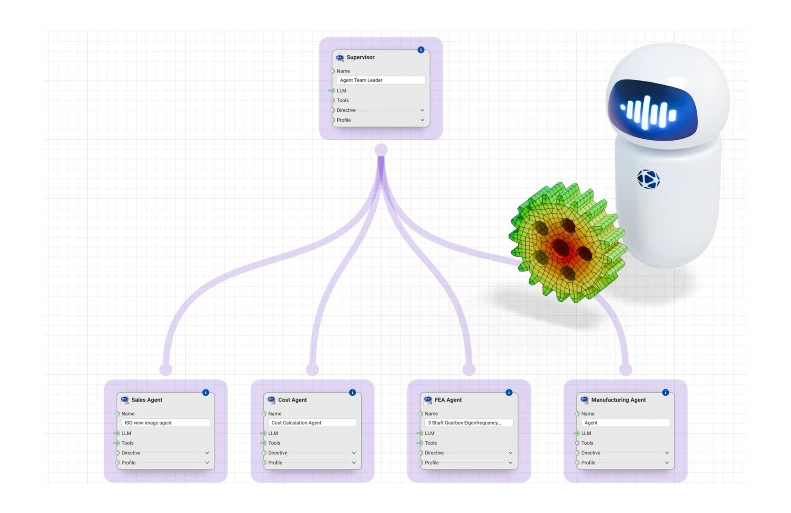
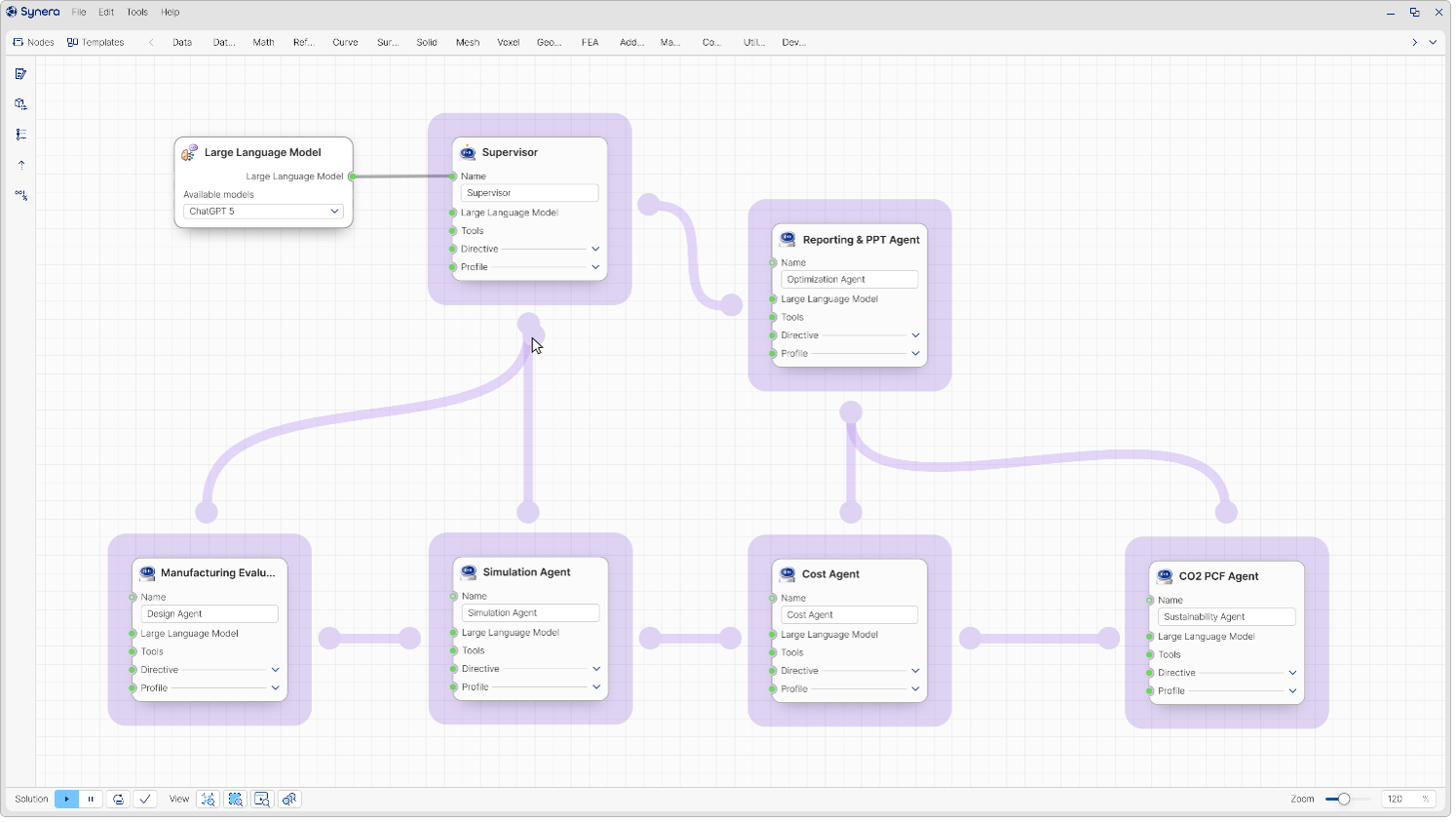
- Agentic layer: A supervisor agent receives a plain-language prompt from the designer. Specialized agents across geometry, simulation, and costing evaluate the inputs, interpret them against SEAT's engineering methodology, and act. A reporting agent then compiles the verdict and any flagged problem areas into a structured report the designer can act on.
How the engineers trust the results from the agentic AI system
The LLM does not evaluate whether the component is manufacturable. The deterministic forming simulation does. The LLM interprets the simulation output against SEAT's engineering methodology and presents it to the designer in structured form. Every result is traceable to the underlying calculation.
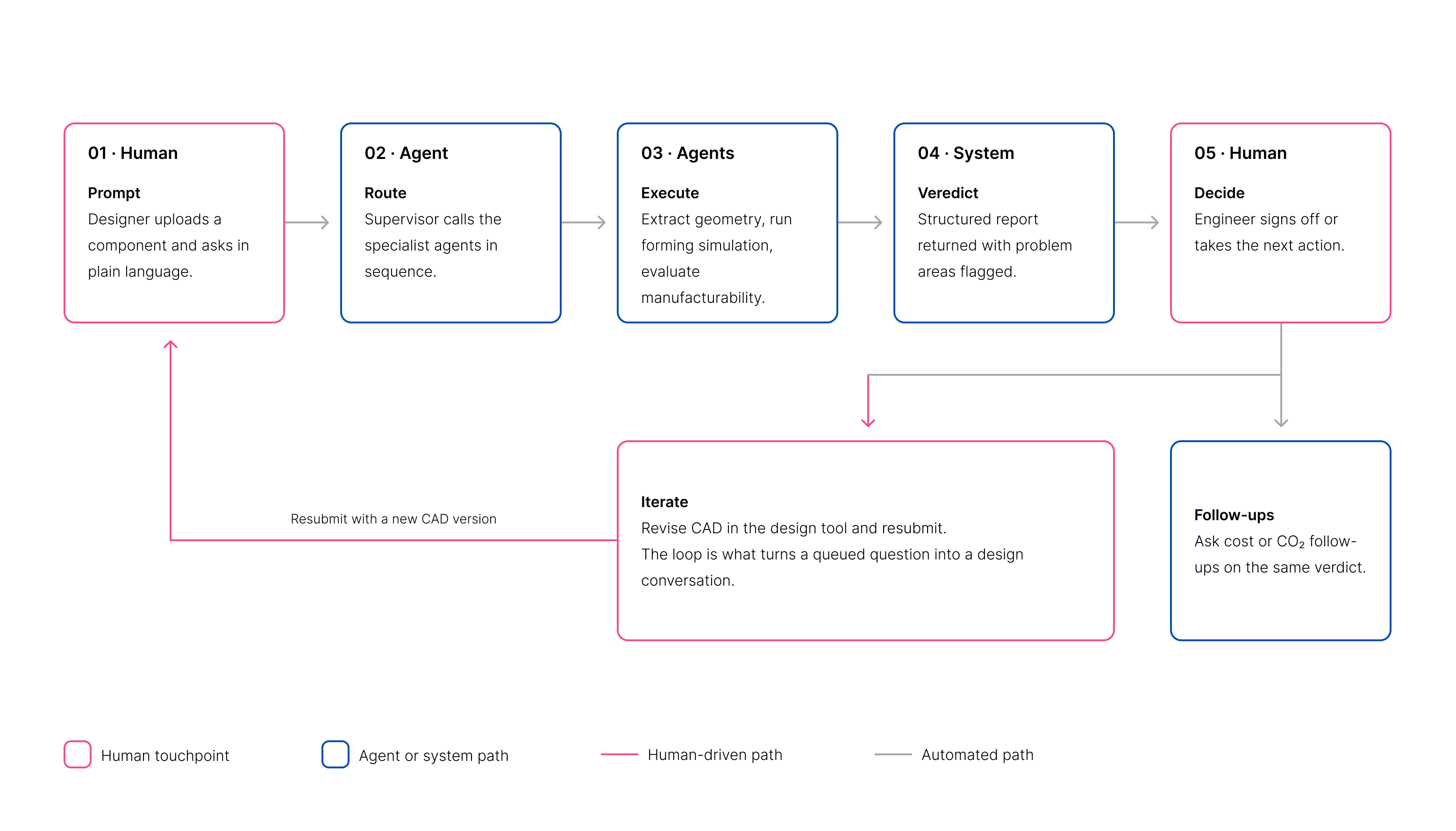
The end-to-end flow, with the engineer in control at every step:
- Designer uploads a component and asks the system a plain-language question.
- The supervisor agent calls the specialist agents in sequence.
- The agents extract geometry, run the forming simulation, and evaluate manufacturability against the material database.
- The system returns a verdict, with problem areas flagged.
- The engineer decides: revise the CAD, resubmit, or ask cost and CO2 follow-ups.
The role SEAT's engineers do is judgment. The role the agents do is coordination and analysis.
SEAT built the system on automation that was already in production, and kept its engineering IP inside SEAT
Every step is grounded in the engineering processes, tools, and logic that SEAT has already operated under. The agentic AI system does not require the engineering teams to replace their tools or set it up from scratch. It natively connects with 80+ CAx and PLM tools, runs securely inside the existing infrastructure, and builds on existing engineering IP.
Secure LLM orchestration with on-premises data handling means SEAT's engineering IP stays inside SEAT. Customers choose their own LLM infrastructure, connect their own tool stack, and retain full control of their data and model configuration.
The knowledge of a senior simulation engineer, encoded in deterministic automation, made available to every designer on the team, without the overhead of a request queue: SEAT's manufacturing feasibility agent is one example of what that looks like in production.
What changed at SEAT: weeks to minutes, feasibility answered during design, engineers back to higher-value work
A body-in-white program can require feasibility assessment on dozens of sheet metal components. Each one that previously joined a simulation queue can now return a result in about thirty minutes. Across a full program, feasibility that once occupied months of calendar time completes in a matter of days.
Across the body-in-white team's workflow automation already in production, the underlying gains are documented: 42 hours to 1 hour on one process, 2 hours to 5 minutes on another (with the automated result more precise than the manual one).
Beyond SEAT: shrinking cycles and tightening budgets across European automotive
The manufacturing feasibility problem does not stop at SEAT's gates. Every European automotive engineering organization is running against the same two macro pressures.
Program cycles are compressing. OEMs are moving from 48–60 month cycles toward 24–36 (Microsoft, CES 2026). At the same time, Europe's cost gap is widening: the 2024 Draghi Report puts the structural cost gap between European and Chinese vehicle manufacturers at approximately 30%.
A body-in-white program cannot absorb weeks of rework in that environment, and adding more simulation engineers still funnels every request through the same specialist queue.
The SEAT approach is a template for how specialist knowledge scales without the specialist queue.
Three lessons other automotive engineering teams can take from SEAT's path
Look at what SEAT started with: CAD models, an established simulation tool stack, a material database, and a body-in-white engineering team carrying deep manufacturing knowledge. Most automotive OEMs and Tier 1 suppliers already have the same. So do most aerospace and defense manufacturers. The decision to move is what separates the program answering feasibility in thirty minutes from the one still waiting weeks.
What SEAT's path makes concrete:
- Start where automation is already proven. SEAT did not begin with a team of agents. They began with automating their existing engineering processes, moved multiple use cases into production, and added the agentic layer once the underlying processes were trusted. Rule-based workflows keep engineering calculations deterministic. The agentic layer coordinates, evaluates, interprets, and acts. The engineer signs off.
- Break the queue that gates the whole sequence. Manufacturing feasibility ran through a specialist queue because that is where the expertise lived. Making that expertise available to the designer via the agentic system is what changes the shape of the program.
- Keep the engineer in control. The system does not decide for the designer. It runs the analysis, flags the issues, and returns a verdict the engineer can act on: revise the CAD, resubmit, or ask a cost or CO2 follow-up. The role SEAT's engineers do is judgment. The role the agents do is coordination and analysis.
The engineering teams that close the gap between design intent and manufacturing reality earliest are the teams that finish the program first.
Start where SEAT started
Three ways to move on this:
- Watch a 7-minute on-demand demo of agentic AI for engineering in action.
- Read How SEAT is building an agentic system with Synera — the extended customer story with the workflow-automation foundation, deployment path, and results in full detail.
- Take the Synera Value Assessment to identify the highest-value engineering process to move first in your organization. The Synera Value Assessment maps your highest-value engineering process to a workflow that can be built in weeks.
Want to see the system running? Juan de Dios Escribano Felguera walks through the SEAT implementation with Tilman from Synera in the full CDFAM presentation. Presented at CDFAM Computational Design Symposium, Barcelona, April 2026. Recording available on YouTube.