An engineer with a modern coding assistant can connect to an API or MCP, parse a file, and return a result in an afternoon. When something that looks like a working tool appears that fast, the instinct to build agentic AI for engineering in-house feels not just reasonable but obvious. For manufacturing CIOs and VPs of Engineering deciding where their teams spend the next two years, that instinct deserves a serious evaluation.
This is a guide to making that decision well: where building agentic AI for engineering yourself genuinely wins, where it quietly costs you, and the questions that separate a spin-up prototype from a system your organization can still run in three years without hidden costs.
Why “we’ll just build agents ourselves” suddenly sounds reasonable for engineering automation
For most of the last decade, automating an engineering workflow meant writing and maintaining real software. That was expensive enough that buying an automation platform was the default for many manufacturers.
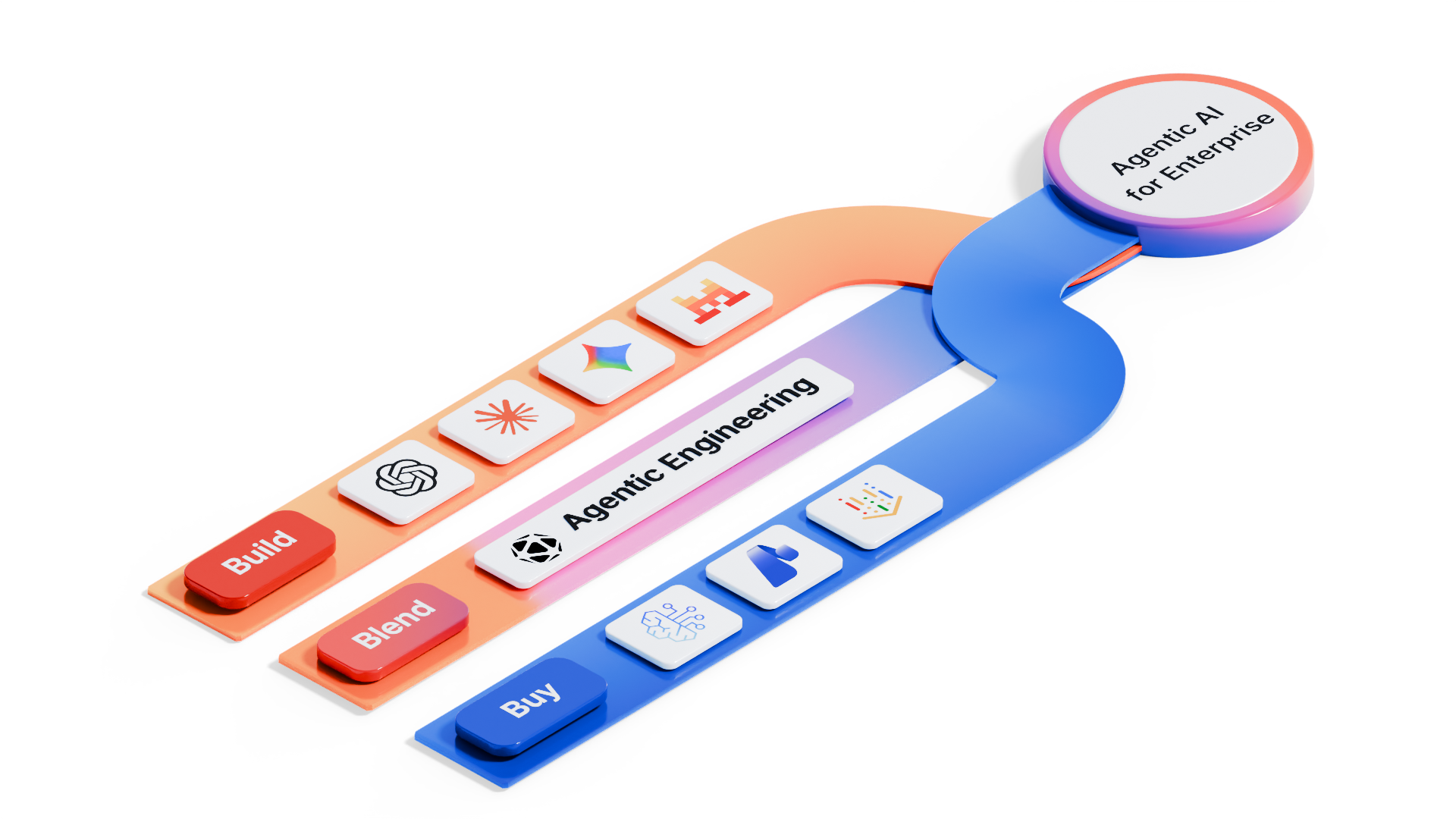
Vibe coding changed the starting line. A design, simulation, or costing engineer can now describe what they want in plain language and get working code back in minutes. The barrier to the first automation prototype has collapsed. The new question every manufacturing and engineering leader is now hearing in some form: if my team can build eighty percent of this, why would we pay for an agentic AI platform?
It’s a fair question. And yet the first question people ask and the questions they should ask are not always the same. In today’s markets, where engineering competitive edge determines which manufacturers will succeed in the next year, accurately evaluating the build vs buy question becomes a strategic imperative.
The honest case for building agents for hardware engineering yourself
A custom tool like Claude Code and other vibe coding tools can be a perfect fit. When you build for exactly one workflow, you can shape it to that workflow precisely, with none of the compromises a third-party platform makes to serve global teams and thousands of automations.
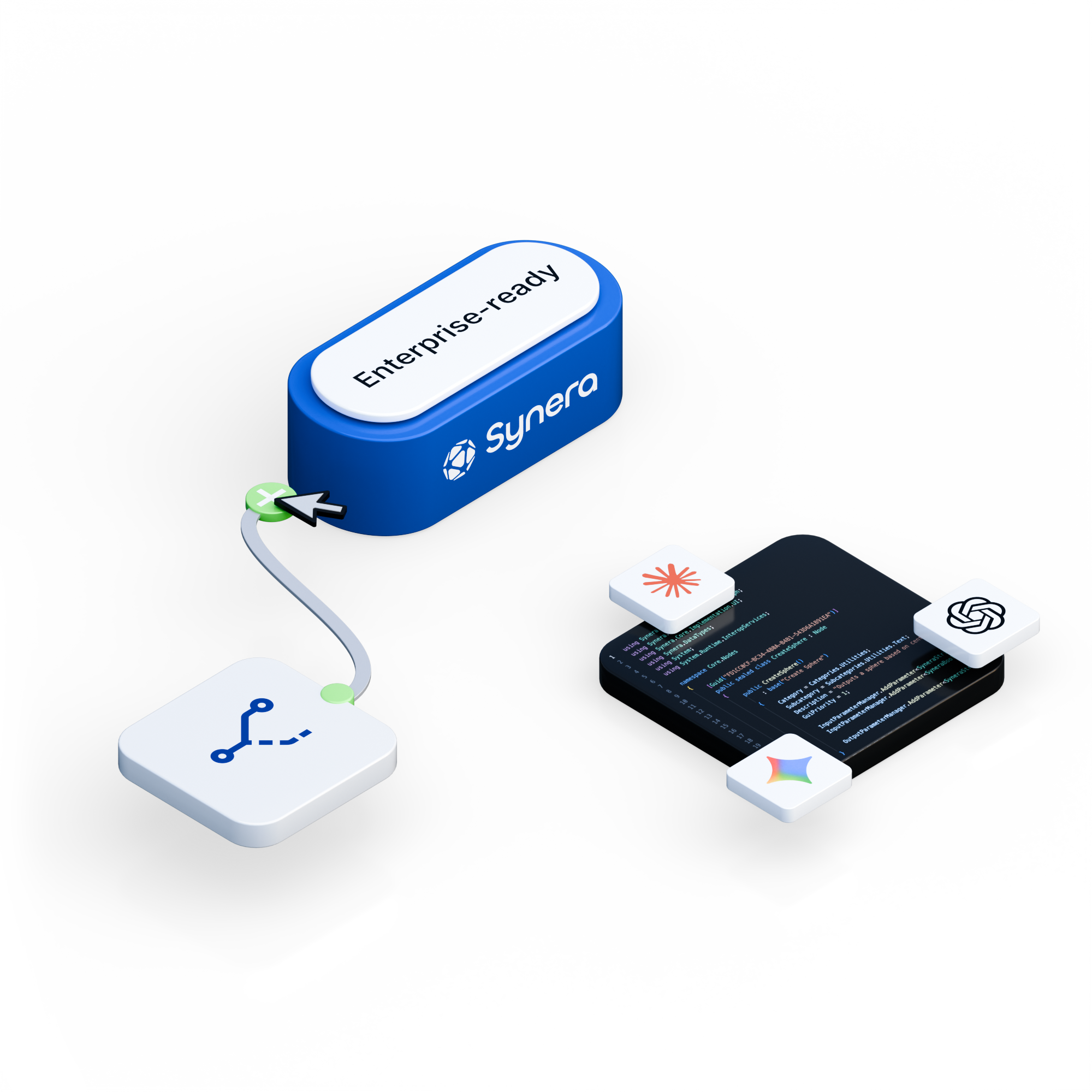
For a well-scoped job that doesn’t require understanding of geometries, the first prototype is fast, cheap, and customized exactly to your needs. With ChatGPT, Gemini and Claude Code, a capable engineer can stand up a working automation in days, sometimes hours.
You keep full control of the intellectual property (IP) that went into the automation design and the roadmap. There are no new systems if the builders use existing technology already in the organization, and you are not waiting on a vendor’s schedule to introduce more agents. For manufacturers that treat their engineering methods as core intellectual property, this level of control matters.
The 80% that ships in a week, and the 20% that doesn’t
The most dangerous number in do-it-yourself engineering automation is 80%. It is the number that makes building look finished when it has just started.
The remaining 20% is everything that makes automation survive a scalability test and organization-wide rollout:
- Reliability and error handling when an CAD model breaks the automation with a variant or input combination the script's author hadn’t anticipated
- Multi-user access and permissions
- Version control and audit trails for regulated work
- Integration upkeep every time a CAD, simulation, or other vendor ships a new API version
- Deployment onto compliant infrastructure
- Scaling from one engineer’s personal workflow to a department’s standard process, repeatedly for each automation
- Services to speed up time-to-value and fill gaps in stretched engineering teams
That last 20% is most of the effort.
If you need to automate a narrow job that’s not mission critical, building it yourself is often right. If you can already see the next ten, twenty, fifty workflows behind it, you are not building an automation, you are building the next era of engineering infrastructure. Are your hardware engineers the right ones to be engineering software?
A prototype that works on one laptop is a fundamentally different thing from a production system the entire research and development organization depends on. Reframe the build vs buy question from “can we build it?” to “should we maintain it?”
5 questions to ask before you decide to build
Here is a framework you can apply to any engineering automation decision:
- Who maintains the integrations? Engineering automation lives or dies on its connections to CAD, CAE, ERP, and PLM systems, and those vendors change their APIs. Building means owning that maintenance forever. Ask who on your team will do it, and what they will stop doing to make time.
- What happens when the person who built it leaves? A brilliant engineer writes a script that automates a critical workflow. It works. Then they get promoted, change projects, or leave, and nobody has the time or skills to debug three thousand lines of code with hardcoded paths. Vibe coded scripts are personal. To make them future-proof the knowledge inside them needs to be organizational, visible, and transferable.
- How critical is the automation to your business – does it need governance, or just to run? A personal helper tool needs to work. A system that touches live engineering needs permissions, audit trails, a secure deployment that satisfies IT and compliance, and the automation output needs to be traceable, repeatable, and precise. If the answer is governance, you are signing up to build an agentic AI platform, not vibe coding scripts.
- Will foundation models make this obsolete next year? It is tempting to assume the large language models will simply absorb the engineering automation problem. They are improving fast at generating code and reasoning over text and images. But engineering automation also needs deterministic execution (you cannot ship a component off a probabilistic result), spatial reasoning over 3D geometry, state held across hours-long high-performance computing (HPC) jobs, and governed tool access across enterprise IT. Those are platform capabilities, not model capabilities.
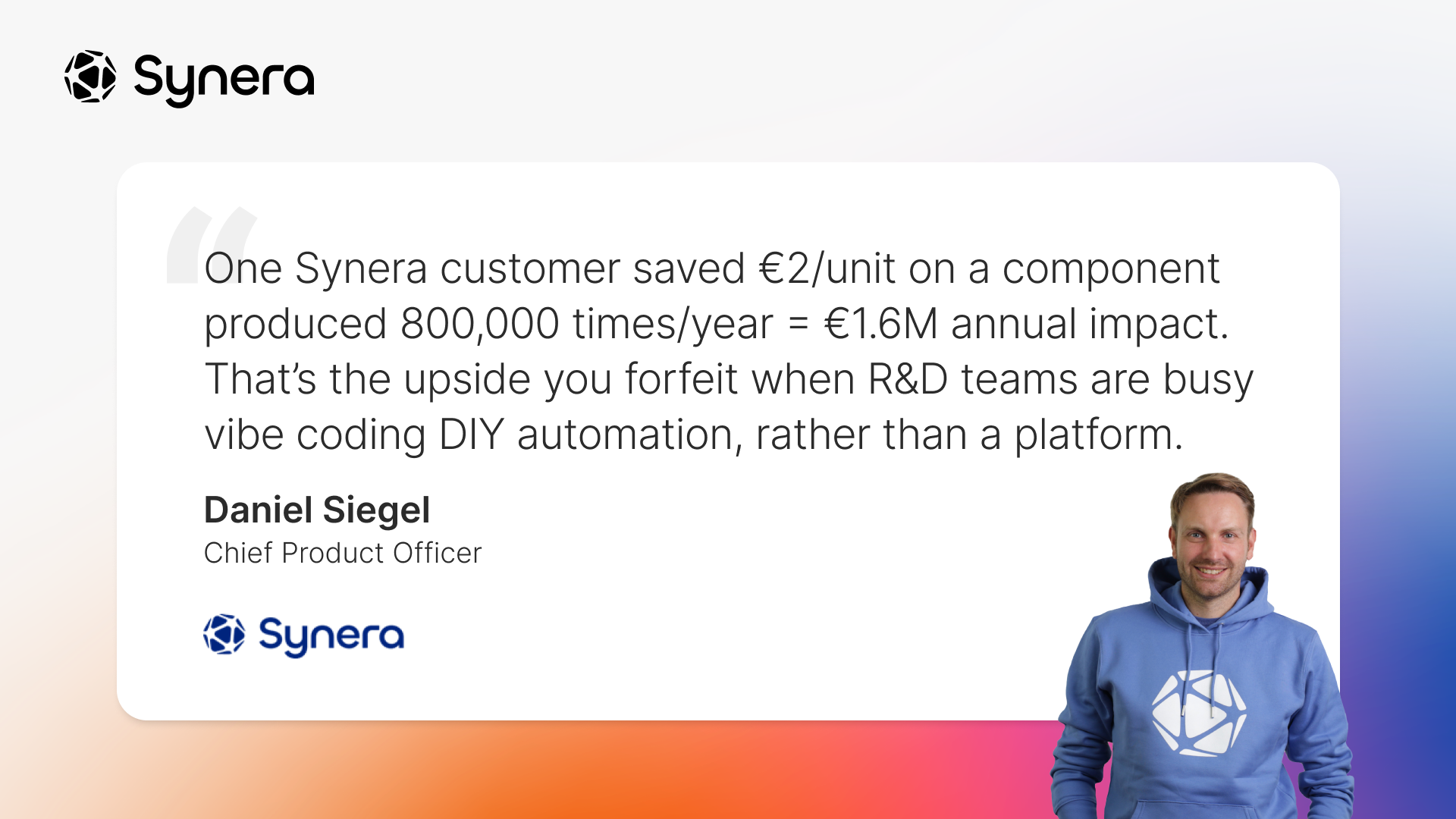
- What does this cost over three years? The platform license and consumption costs are the visible number. The invisible costs: a single custom workflow is months of senior-engineer time to build, then continuous maintenance as APIs change and users onboard, then a fresh start for the next workflow. Every hour your best engineers spend maintaining software plumbing is an hour they are not doing the hardware engineering only they can do. Put a number on it: one Synera customer saved €2/unit on a component produced 800,000 times/year = €1.6M annual impact. That is the upside you forfeit when your R&D team is busy building DIY automation, rather than using a finished platform.
Where an agentic AI for engineering platform earns its place
Engineering organizations at automotive, aerospace, defense, consumer electronics and appliances manufacturers have fragmented toolchains across the product lifecycle, hundreds, even thousands, of workflows, and strict industry compliance standards.
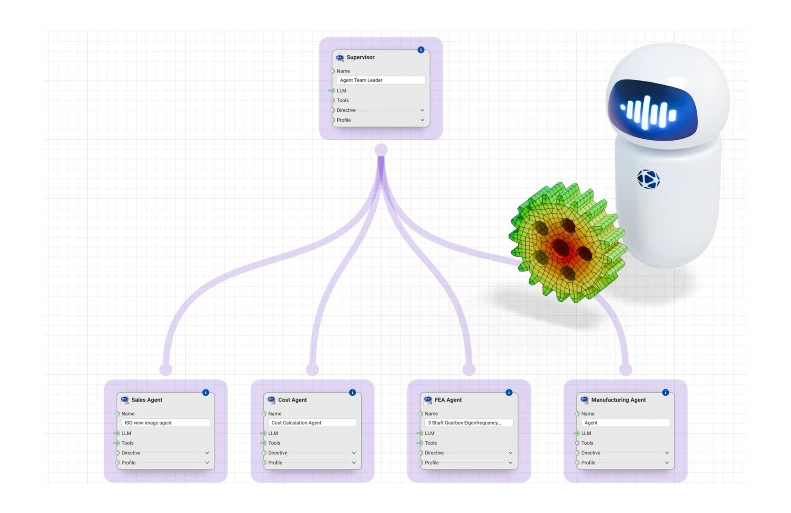
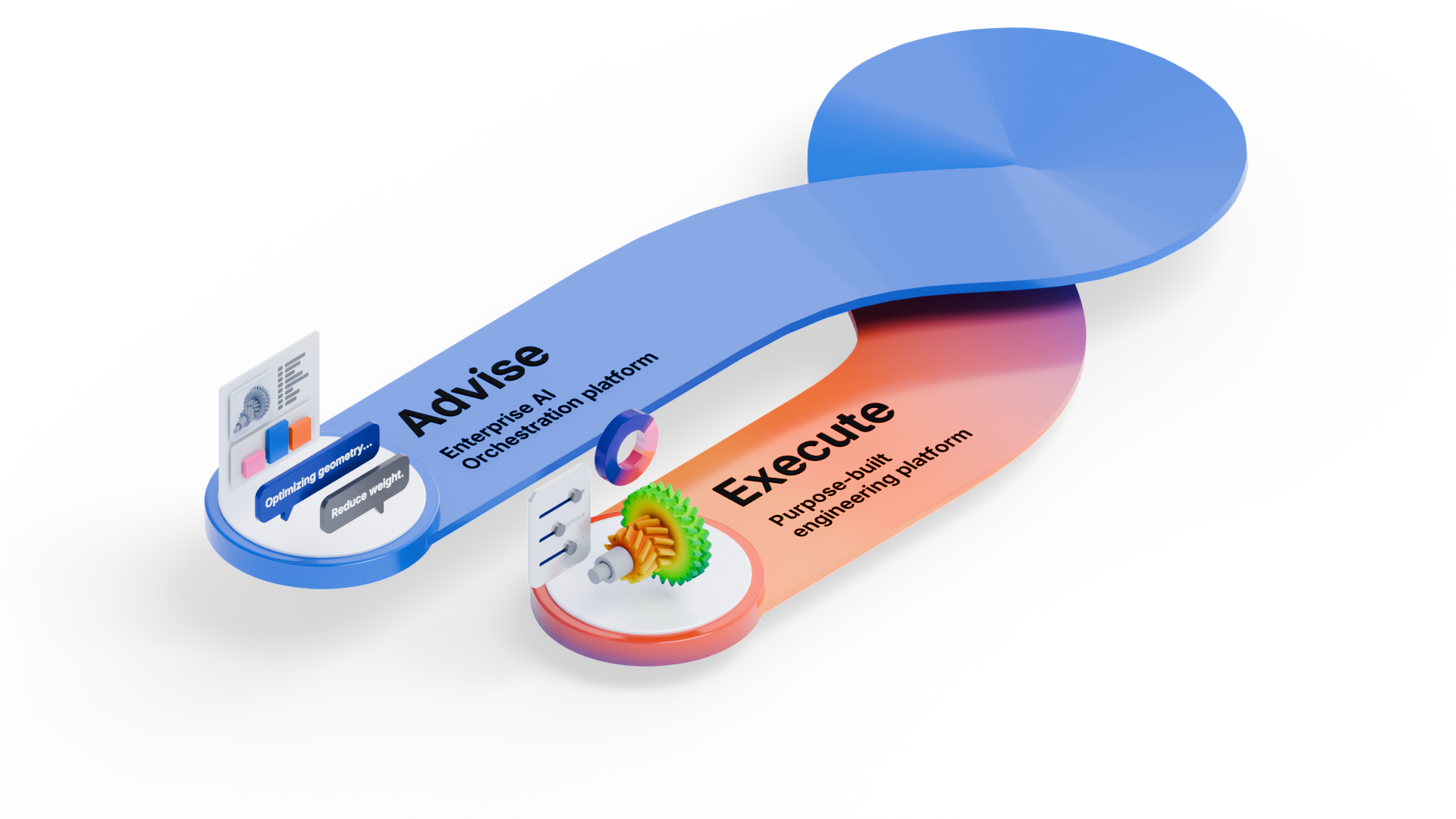
This is the environment Synera was built for: agentic AI for engineering that connects across CAD, CAE, costing, and PLM tools, with a team of agents ready to execute precise engineering work that follows your methods and intellectual property.
Engineering automation needs precise execution, because you cannot ship a component based on probabilistic simulations, and a better foundation model does not fix geometries, build meshes, run precise simulations, or guarantee repeatable results on its own.
The difference shows up in the data and what the platform makes possible:
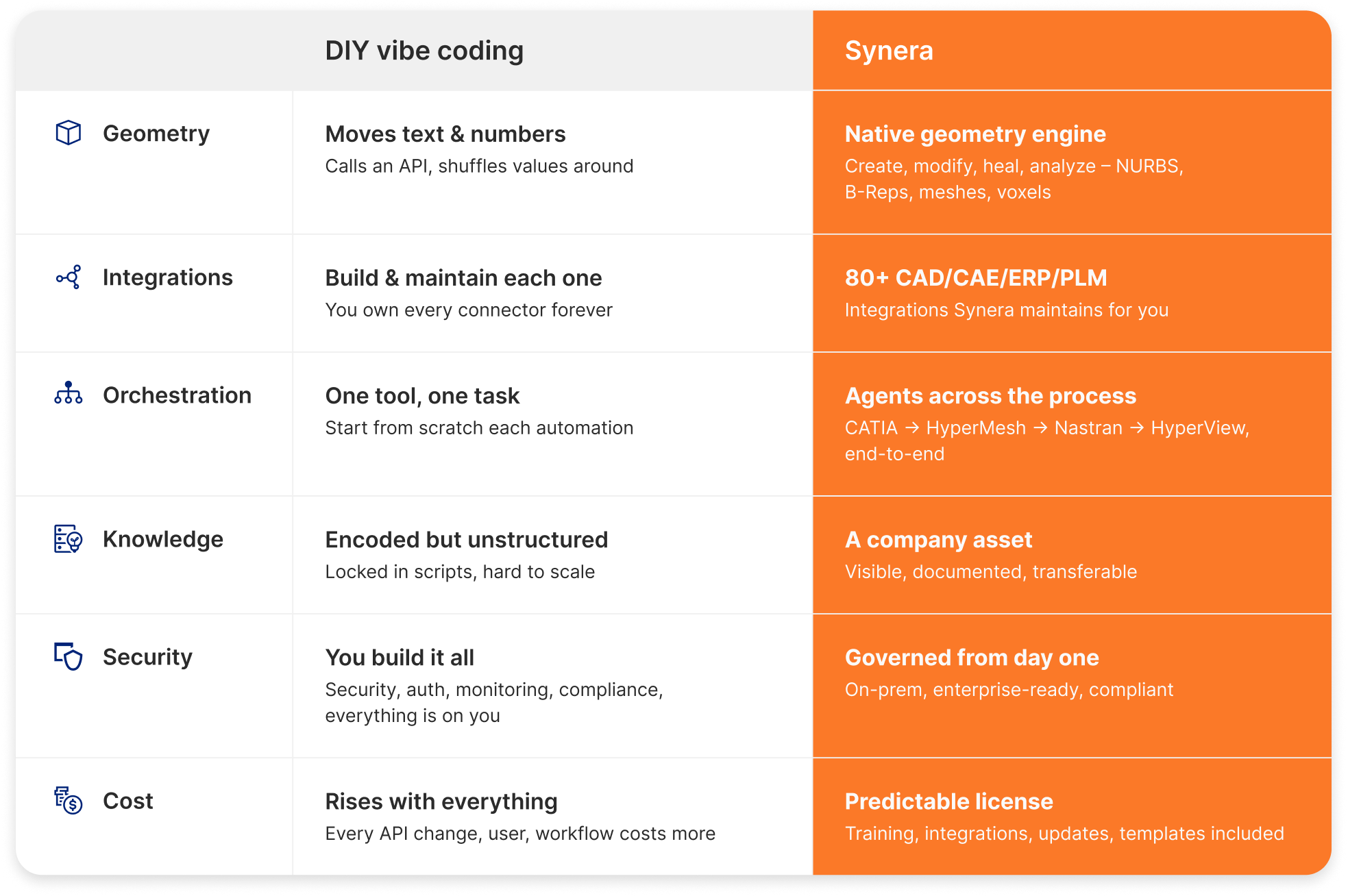
For a closer look at how an agentic AI platform for engineering works in practice, see Synera’s writing on scalable agentic systems for engineering and the IMS Gear: 99% faster RFQ with agentic AI videos.
What the build vs buy decision is really about
This decision is not “can your engineers build it.” Of course they can. With today’s foundation models they can build prototype agents faster than ever. The decision is whether you want them spending the next two years maintaining the integrations and chasing the scalable cases or doing the mechanical engineering only they can do and build the products that are genuinely one-of-a-kind to your quality standards.
Agentic AI for engineering infrastructure is meant to speed up stretched R&D engineering teams, not quietly distract them with software building whose opportunity cost erodes your competitive advantage.
Want to see what that looks like in production? Read how Airbus, NASA, BMW, SEAT, and IMS Gear made the build vs buy call and what their teams do now: explore the customer stories.
About the Author:
Daniel Siegel
Chief Product Officer
Daniel Siegel is the co-founder and managing director of Synera, a company reimagining how engineers create by helping them to build digital co-workers that think and collaborate like humans. With more than twenty years of experience in software development and engineering, he has helped some of the world’s leading companies in automotive, aerospace, and consumer goods rethink how products are designed and built. Having studied across six countries, Daniel brings a global perspective to technology, creativity, and innovation. Holding a Master’s in Business & Engineering and a Nanodegree in Deep Learning, he combines technical expertise with entrepreneurial vision — driven by one mission: to empower every engineer to shape the future.