From weeks to 10 minutes: how IMS Gear put agentic AI for engineering in production
IMS Gear, a 106-year-old automotive Tier 1, built a team of agents on Synera that turns a customer request for quotation (RFQ) into a finished quote in 10 minutes, a process that used to take multiple weeks. The system is in production with 100+ quotes already run through it. The blog explores the success story of how the engineering team built it themselves, the functionality of the system, and what it means for tier-1 suppliers in the automotive industry looking for a competitive advantage.
Prefer the video version? Watch the full webinar with the IMS Gear engineering team.
Speed wins the RFQ, and the average supplier is getting slower, not faster
To understand why IMS Gear moved, look at what the 2025 Center for Automotive Research update found about how automotive suppliers are quoting today:
- Program cycles are compressing. OEMs are moving from 48–60 month cycles toward 24–36 (Microsoft, CES 2026). Quoting late means losing before the program starts.
- RFQ volume is up 62%. The average supplier now handles over 800 RFQs per year, up from 495 two decades ago.
- Time per RFQ is up too. From 134 hours in 2002 to 157 hours in 2025.
- Higher hit rates, but not from efficiency. CAR concludes the gains came from more hours per RFQ, more people on each bid, and more organizational effort.
- Knowledge is walking out the door. Nearly 90% of suppliers said staff turnover, retirements, and reassignments are degrading the quality and timeliness of their RFQ responses. The expertise needed to quote well sits in a small group of experts, not in processes.
The RFQ-to-quote process at IMS Gear ran through what Dr. Jens Fechler, Head of R&D, calls "companies inside the company": a metal department, a plastic department, and an industrial department, working in sequence on their piece of the quote. This meant engineers retyping numbers from one tool into the next, sending PDFs across desks, and waiting for the previous department to finish across weeks.
We wanted to deliver quotations to the customers faster, not in weeks.
Dr. Jens Fechler, Head of R&D, IMS Gear
IMS Gear moved on agentic AI while most of the industry was still planning pilots
The CAR 2025 study found that most automotive suppliers have not yet applied AI to quoting, though many plan pilots within the next twelve months.
We had already used Synera in another engineering project. When agentic AI became viable, we jumped on it, one of the first to move it into production.
Dr. Jens Fechler, Head of R&D, IMS Gear
When agentic AI for engineering became viable, they were among the first Synera customers to build on it, breaking away from what the industry expected from A 106-year-old supplier of gears and actuators.
A supervisor and three domain agents run the RFQ end-to-end within 10 minutes at IMS Gear
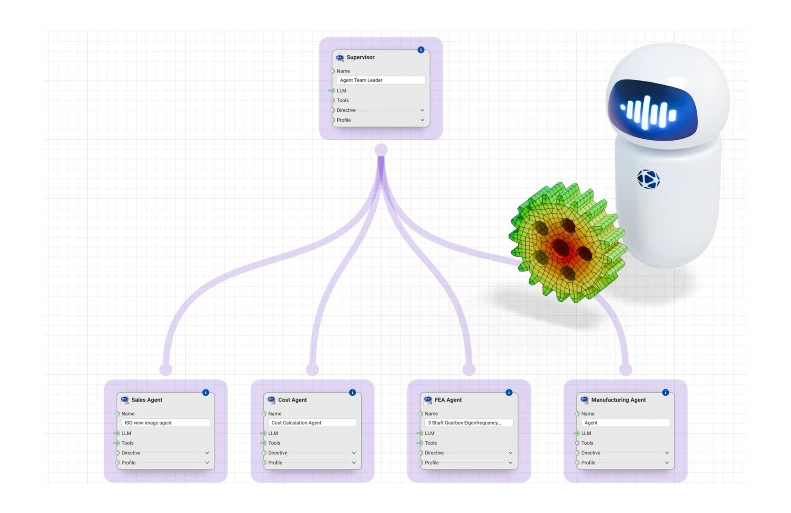
The system IMS Gear's engineering team built for RFQ-to-quote is a team of specialized agents coordinated by a supervisor, structured in three layers:
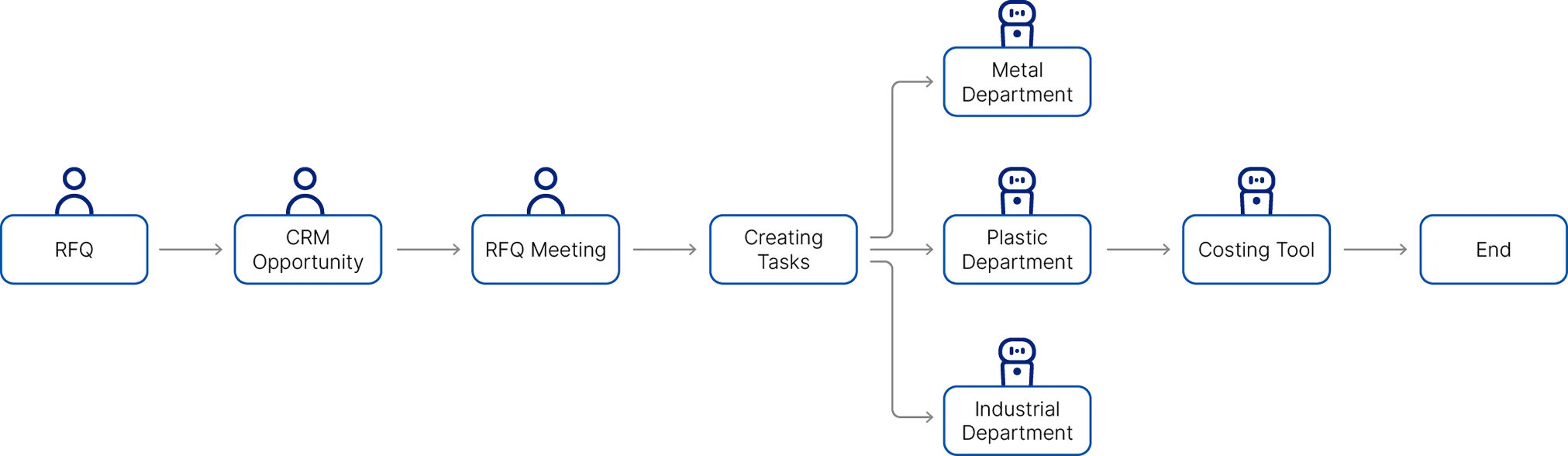
- Data layer: An agent ingests the incoming PDF and CAD files, classifies them, and loads them into the product data management system.
- Workflow layer: Rule-based engineering workflows interpret the data against IMS Gear's tables based on an in-house algorithm refined over years.
- Agentic layer: A supervisor routes each request to the right domain agent (plastic, metal, or industrial), which confirms a handful of details with the engineer and compiles the result into IMS Gear's proven calculation sheet.
IMS Gear's engineers built the system themselves in four iterations, starting with the plastic department
The engineering team built and validated the system themselves, then tightened it iteration by iteration with the fourth iteration going into production:
- Run the RFQ by hand.
- Run it through the system.
- Compare the numbers.
- Tighten the rules.
- Run it again to check every quote that was correct in a previous iteration had to come out correct in the next.
The engineering team at IMS Gear started with the plastic department, which represents the bulk of IMS Gear's business. Metal and industrial will follow, with the costing tool connecting by API.
We didn't have to touch a lot of the process. We simply used Synera and the agent orchestration to connect everything together."
Eric Stähle, Development Engineer, IMS Gear
Synera connected directly to IMS Gear's existing tools: CAD, PDM, calculation sheets, costing tool. This meant there was no new platform to migrate to and no existing data shift to manage on top of existing engineering and business challenges.
What changed: weeks to minutes, 99% faster processes, and engineers back to judgment
At the beginning, I needed two of my engineers doing the RFQs, but today it can be done by one. Doing the same amount of quotations, and then going even faster.
Dr. Jens Fechler, Head of R&D, IMS Gear
We brought the engineers back into the decision-making role. The engineers did a lot of what we call donkey work, putting data from one tool to the other."
Dr. Jens Fechler, Head of R&D, IMS Gear
Three lessons other hardware manufacturers can take from IMS Gear's path
Look at what IMS Gear started with: CAD models, drawings, costing rules, and a stack of engineering tools built up over years. Most automotive suppliers already have the same. So do most aerospace, defense, and industrial manufacturers. The decision to move is what separates the supplier quoting in 10 minutes from the one still quoting in 10 days.
What IMS Gear's path makes concrete:
- Pick one critical business case first: Choose a high-volume process with repeatable rules with a direct line to revenue. Some winning entry way use cases are RFQ-to-quote, design-to-cost, simulation prep, concept evaluation, and manufacturing feasibility.
- One department at a time: IMS Gear started with plastic, the bulk of the business. Metal and industrial followed. This ensures easier adoption, faster iterations, and a stronger foundation for the rest of the organization to build on.
- Standardize before you automate: Rule-based workflows ensure engineering teams keep a result they can sign their name to. The LLM interprets while the rules decide.
Right now, the whole company is looking at us, how we can improve also other topics and other processes in the company.
Dr. Jens Fechler, Head of R&D, IMS Gear
The plastic department was the proof of concept. The rest of the company is the plan.
Start where IMS Gear started
Two ways to move on this:
- Watch a 7-minute on-demand demo of agentic AI for engineering in action
- Take the Synera Value Assessment to identify the highest-value RFQ or engineering use case in your organization