
Aerospace and defense’s AI problem isn’t the AI. Read the Gartner trends for 2026
The new Gartner® report names the trends reshaping A&D engineering in 2026, and why so many AI initiatives stall before production. Read the analyst view on model-based engineering, simulation governance, and agentic AI for engineering.
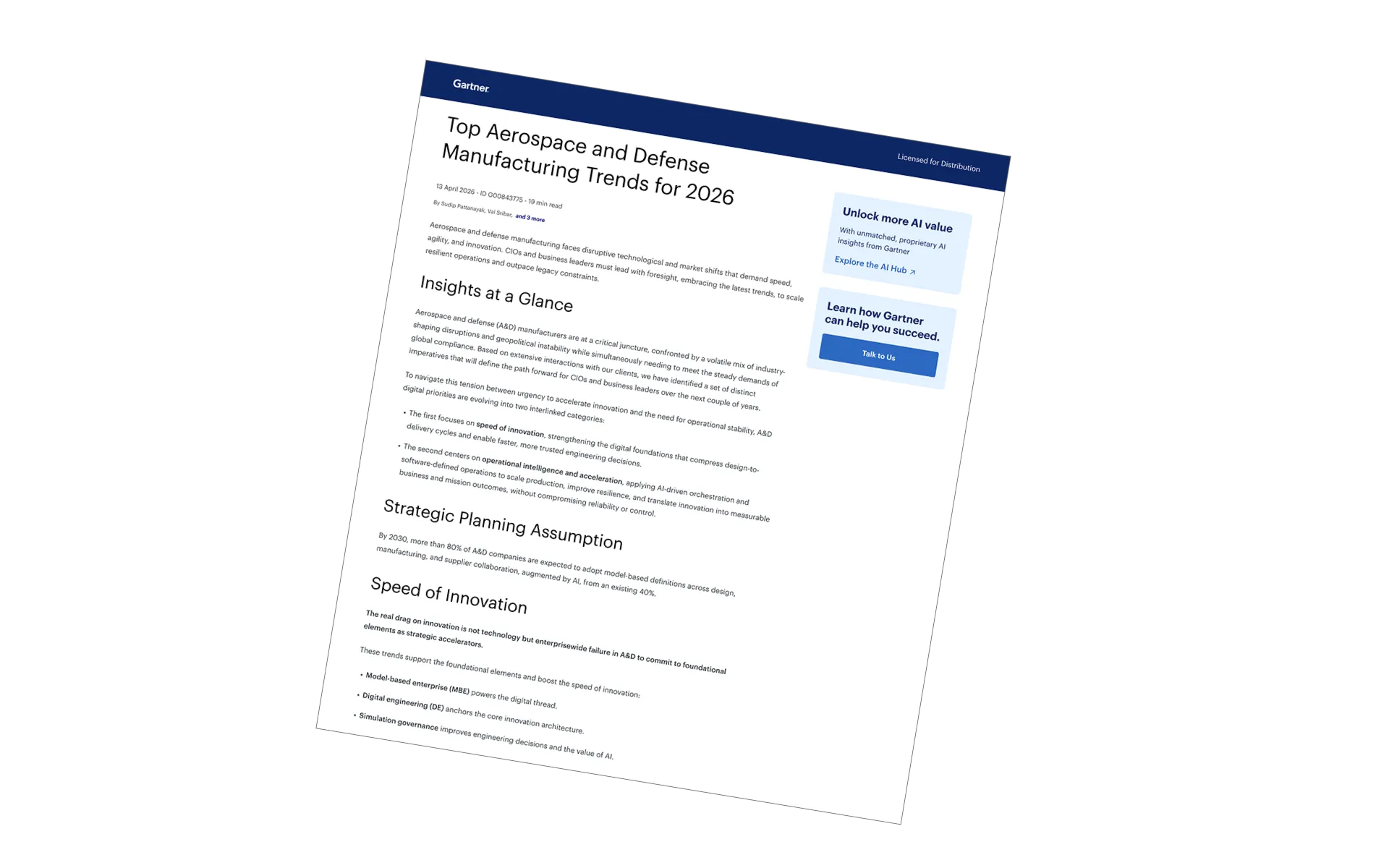
Aerospace and defense is under more pressure than it has been in a generation. The commercial aircraft backlog has passed 17,000 aircraft, around twelve years of current production capacity, while a skilled-labor shortage is widely cited as the top production constraint. Appetite for AI is high, 57% of A&D executives already report using AI-enhanced design and engineering (PwC, Future of Industrials), but ambition keeps outrunning readiness. This Gartner report explains why, and what the trends point to next.
What the report covers
- Speed of innovation, built on model-based enterprise, digital engineering, and simulation governance, and
- Operational intelligence, built on ontologies, software and AI-defined factories, dynamic supply chains, and agentic AI for orchestration.
The throughline is direct. As Gartner puts it, “The real drag on innovation is not technology but enterprise-wide failure in A&D to commit to foundational elements as strategic accelerators.”
(Gartner, Top Aerospace and Defense Manufacturing Trends for 2026, 13 April 2026.)
Why download this asset:
- Understand why AI initiatives stall before production, and what foundations let them scale.
- See the full set of A&D engineering trends for 2026, assessed by Gartner analysts.
- Get a forward view on the model-based shift: Gartner expects adoption to rise “from an existing 40%” to “more than 80% of A&D companies” by 2030.
Complete the form to read the full Gartner® report, available for a limited time
Gartner is a trademark of Gartner, Inc. and/or its affiliates.
Gartner, Top Aerospace and Defense Manufacturing Trends for 2026, Sudip Pattanayak, Val Sribar, Jay Phipps, Marc Halpern, Michael McFerron, 13 April 2026.
Don't miss the next Gartner report.
Sign up for our newsletter.
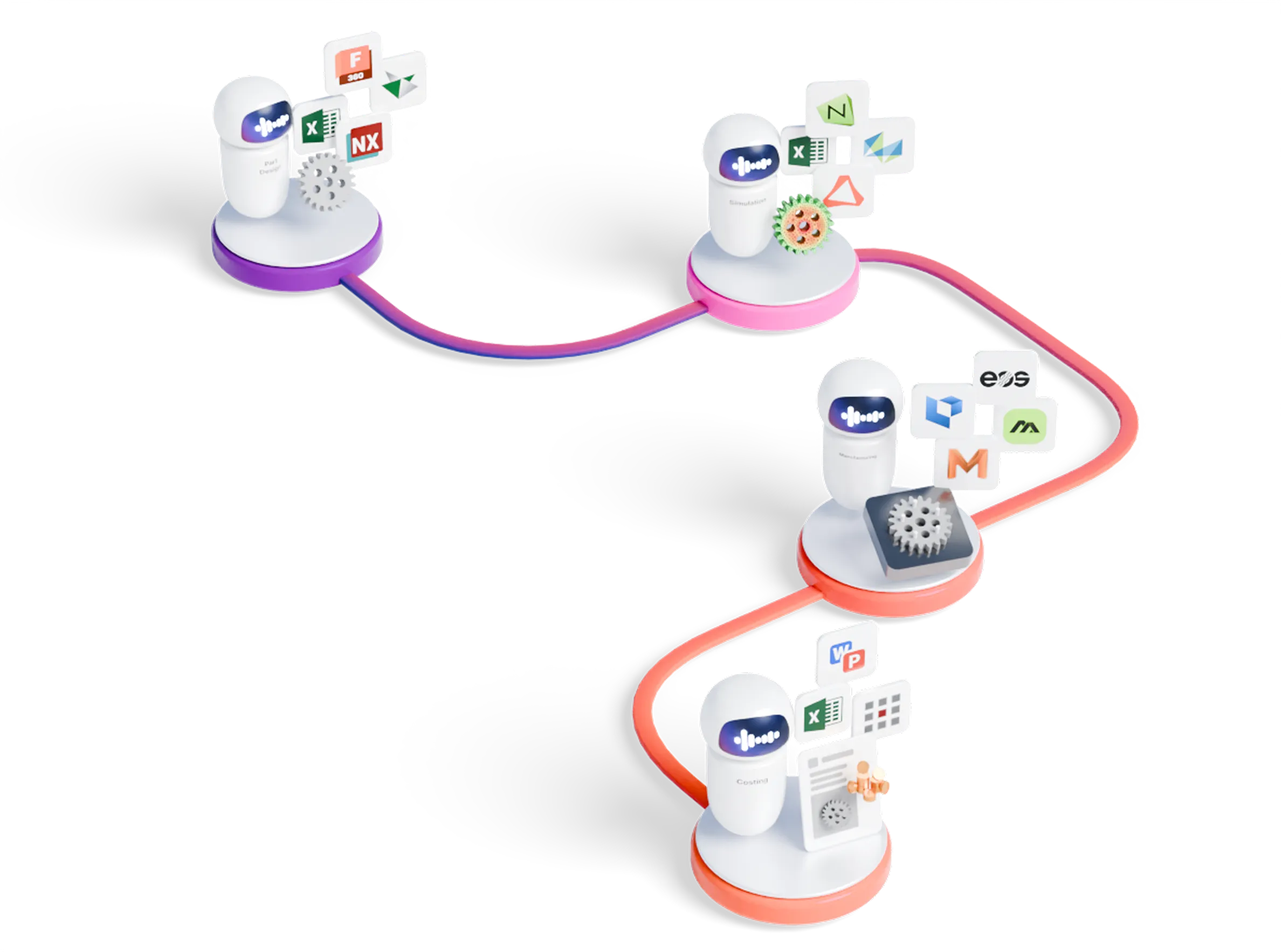
Synera’s approach to agentic AI for engineering
We built Synera on a simple belief: AI only changes engineering when it can do engineering. Synera is the leading platform for agentic AI for engineering. It connects the CAD, CAE, PLM, ERP and costing tools A&D teams already trust, then runs teams of agents that execute real engineering work across design, simulation, and costing, with every step logged and auditable and your engineers directing the work. Deployed on-premises, it keeps sensitive engineering IP inside your environment. The result is a path out of stalled pilots and into production, so engineering capacity turns into throughput.
NASA, Airbus, Safran, and Arianespace are among the aerospace and defense organizations that run engineering on Synera. At Airbus, request-for-tender turnaround moved from 50 hours to 7 minutes. At NASA, design exploration that once took two engineers two days to produce four variants now lets a single engineer explore more than 100 variants in an hour.
Frequently Asked Questions
It sets out the top aerospace and defense manufacturing trends for 2026 across two themes, speed of innovation and operational intelligence, including model-based enterprise, digital engineering, simulation governance, software and AI-defined factories, and agentic AI for orchestration.
Our view of Gartner report is that foundations get deferred in favor of the next technology, which leaves AI without the governed models and connected data it needs to scale. In the report’s words, “AI hype cannot compensate for poorly governed models, inconsistent information, or unclear system states, especially in a highly engineered industry.”
(Gartner, Top Aerospace and Defense Manufacturing Trends for 2026, 13 April 2026.)
Gartner expects model-based definitions, augmented by AI, to move “from an existing 40%” to “more than 80% of A&D companies” by 2030.
(Gartner, Top Aerospace and Defense Manufacturing Trends for 2026, 13 April 2026.)
No. Our understanding of the direction across the report is augmentation: AI takes on coordination and execution at a scale human-centric processes cannot match, while engineers stay in the directing and decision-making role. That is also how Synera is designed to work.