The new Capgemini Research Institute report on why AI in automotive engineering stalls between pilot and production
800 automotive executives on adoption, governance and traceability, with Synera CEO Moritz Maier among the experts quoted
Why it matters now for engineering leaders
Key stat: 68% of automotive organizations require human approval for high-impact decisions. Only 41% can trace the data, assumptions and reasoning behind an AI-influenced outcome.
Agentic AI is already part of automotive engineering: 35% of the organizations surveyed use it, and another 33% are piloting it. The hard part comes after the pilot. Only 5% describe their AI governance as fully mature, and most can't show an engineer how an AI recommendation was reached. The report maps where that gap sits and what the companies pulling ahead do about it.
What’s inside the report
"In my experience, the technology is no longer the primary barrier to adopting agentic AI. Most organizations already recognize its potential. The real challenge is redesigning processes, decision-making structures, and ways of working so that AI can be scaled effectively and deliver measurable business impact."
Moritz Maier, CEO & Co-Founder, Synera
An independent study by Capgemini Research Institute, based on a survey of 800 executives at OEMs, tier-1 suppliers and technology providers in 12 countries, run in July 2026, plus 24 interviews with automotive engineering leaders and industry experts.
The five recommendations in the report:
- Scale AI across product development in parallel instead of one step at a time
- Build an agentic control plane grounded in evidence and traceability
- Make engineering data machine-interpretable
- Manage engineering across three lifecycle metrics
- Close the loop between vehicles in service and engineering teams
Who should read it?
VPs of Engineering, Heads of AI and R&D leaders at OEMs and suppliers who already have an AI pilot running and now have to decide what it takes to run it in production: who signs off, how results get traced, and how data moves between the tools.
Capgemini Research Institute, Rewiring automotive product development: How organizations can pull ahead in the AI race, published 12 October 2026.
Don't miss the next analyst report. Sign up for our newsletter.
Synera’s approach to agentic AI for engineering
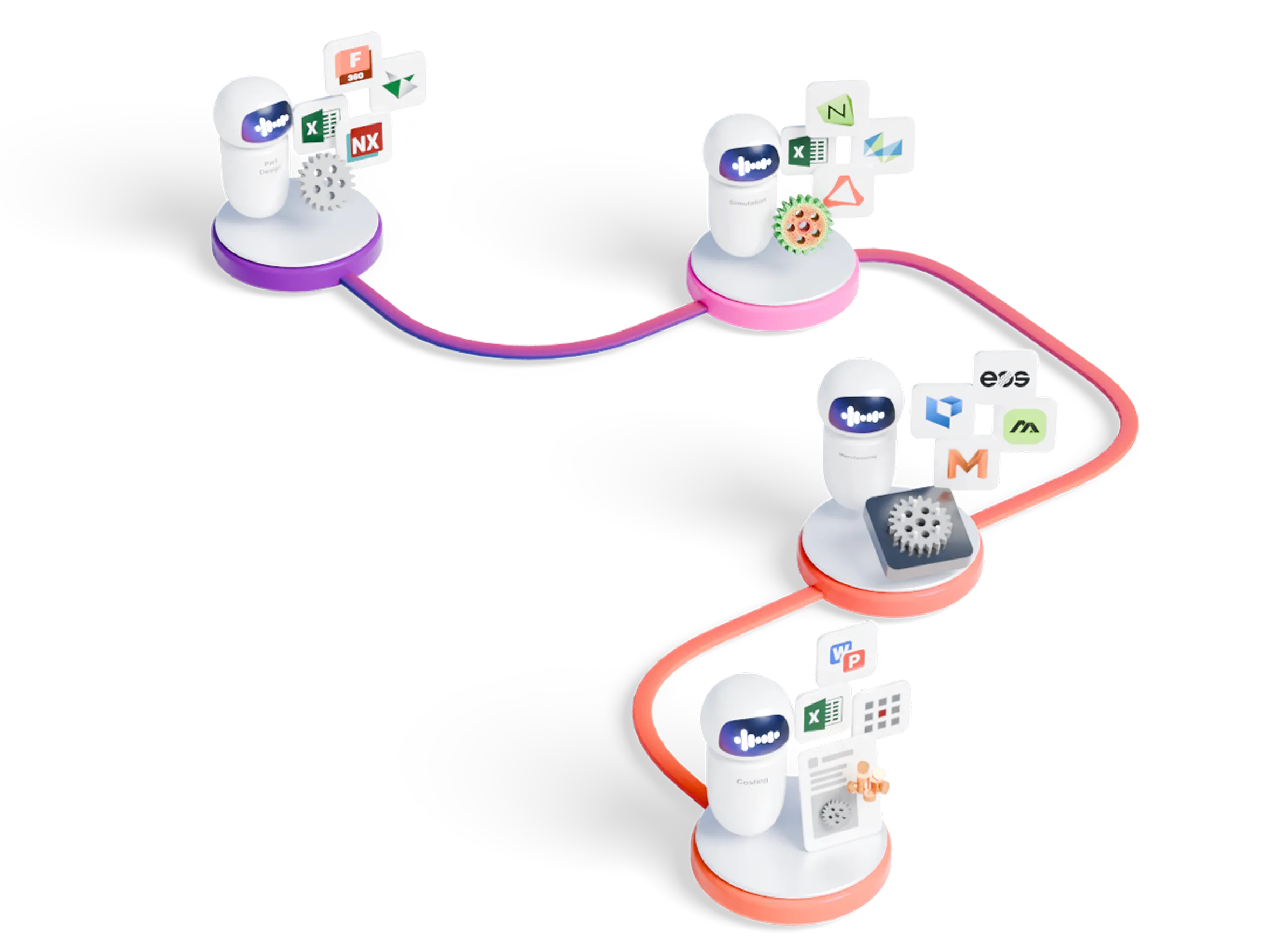
Closing the gap the report describes depends less on the next model and more on how engineering work is set up: who decides, what gets logged, and how a result moves from one tool to the next. Synera connects to more than 90 engineering tools, runs deterministic workflows where every step is logged and auditable, and deploys on-premises so engineering IP stays in-house. Six of the world's top 10 automakers by revenue rely on Synera.
- BMW: a 3-week design cycle reduced to 2 minutes
- IMS Gear: RFQ-to-quote from multiple weeks to 10 minutes, with one engineer handling the volume that used to need two
- SEAT: one body-in-white step from 2 hours to 5 minutes, and more precise
- Airbus: request-for-tender turnaround from 50 hours to 7 minutes
- NASA: one engineer explores 100+ design variants in an hour (previously two engineers, two days, four variants)